
































The Pharma Media Measurement Manifesto
Introducing the “SOLLI” framework for pharma media measurement.


This article is part of solli’s August series exploring Metrics and Measurement.
In pharma media, measurement is meant to connect marketing efforts to real-world health outcomes, essentially proving ROI for each dollar of pharma or healthcare company’s ad spending.
In many ways, however, the system is broken. Measurement often falls short of accurately and comprehensively measuring the impacts of a given campaign, and media teams are left struggling to fill in the gaps.
In short, pharma media measurement needs a new standard: one that values meaningful outcomes over superficial metrics, breaks down silos to reduce cross-channel fragmentation and better engage HCP and patient audiences, and uses every signal to fuel future decisions. Good measurement is transparent, compliant and actionable, able to prove not merely that a campaign happened, but that it drove the behaviors and business outcomes that actually matter.
What follows is a roadmap to help reach that end goal, identifying key issues in the current pharma media measurement landscape and redefining what good measurement can look like in practice.
Through it all, one idea is resoundingly clear: It’s time for a reset in pharma media measurement.
The measurement mess
As it stands, pharma media measurement is plagued by a plethora of issues that will continue to stymie potential until they’re addressed.
For one, success is often defined by what’s easiest to measure rather than what truly matters. “Vanity metrics” like impressions, views and click-through rate have long been used as proxies for meaningful engagement that leads to a specific action or decision that can then result in improved health outcomes; in fact, all they show is that an individual saw or clicked on an ad.
On a related note, the onslaught of new technologies and access to ever more healthcare data have led to an explosion in the metrics available to marketers. It may be tempting to demonstrate progress via such granular data, but at the end of the day, a smaller group of more broadly meaningful metrics will outperform a never-ending list of ultra-narrow numbers every time.
Finally, there’s the oft-cited problem of fragmentation throughout pharma media measurement, again spurred on by the tech boom in recent years, along with the now-ubiquitous omnichannel approach to marketing. Every channel comes with its own set of metrics and methodologies that typically don’t mesh easily together.
Such fragmentation can also exacerbate the issue of accurately evaluating audience quality, when patients and HCPs are represented differently in each channel and partner’s dataset and regulatory rules constrain how sensitive healthcare data can be accessed or manipulated.
These challenges are just a handful of the many holding back good measurement in pharma media, but starting by addressing them may do a great deal in moving the field forward.
The “SOLLI” measurement framework
A handful of key concepts emerge as absolutely crucial in defining a comprehensive pharma media measurement system that demonstrates real ROI and human results.
- Standardized and Standard-Led: Pursue consistency in metrics and data offerings across publishers, platforms and software partners for more cohesive measurement across channels. Make certain that all data-powered metrics not only comply with privacy and regulatory regulations but also actively contribute to successful measurement. The best data practices are comparable, transparent, privacy-safe, actionable and incremental.
- Outcome-Focused: Prioritize evaluating more impactful, sustainable results like engagement and behavior change, rather than surface-level metrics unlinked to any specific action.
- Linked to Action: Ensure that every single metric that goes into a calculation of campaign success has a purpose and drives action, and that measurement around each campaign produces tangible insights that can be implemented into the next.
- Longitudinal: Refuse to keep metrics siloed by channel, opting instead to follow target HCP and patient audiences across touchpoints—each an opportunity to drive awareness, education, action or loyalty.
- Integrated From the Start: Embed measurement in media strategies from the very beginning to help define business questions, desired outcomes and measures of success well before a campaign goes live, rather than relying on them only for post-mortem recaps after the fact.
With this “SOLLI” system in place, marketers would be free to dig deeper into campaign results and redefine success.
HCP marketing, for example, could place a greater focus on increasing clinical awareness, qualified reach, scientific engagement, guideline adoption and appropriate prescribing. And for patient-facing campaigns, success could be defined by improvements in awareness and education, qualified reach, diagnosis, treatment initiation, adherence and persistence.
Whoever a campaign’s target audience may be, a system of measurement built around these guiding tenets enables marketers to measure the more profound and business-impacting effects of campaigns, including less quantitative criteria like brand trust and changes in behavior, decision-making and culture.
Putting it into action
Many of the pieces of a successful, coherent system of pharma media measurement are already in place—it’s just a matter of linking them together and implementing them correctly to achieve the goal of good measurement.
At its core, the system defined above is aimed at empowering marketers to measure campaign success more accurately and thoroughly, across a scoreboard combining fundamental indicators of media quality, audience engagement and commercial impact.
When it comes to assessing individual metrics, a simple hierarchy should be followed, with basic measures of delivery at the bottom, superseded by those criteria that demonstrate attention, understanding, behavior and, at the top of the pyramid, business outcomes.
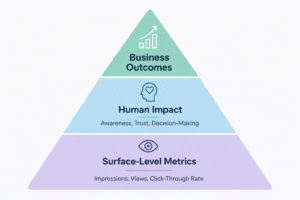
Each member of the pharma media ecosystem has a role to play in an interconnected system of measurement that places such weight on metrics to show actual impact.
For marketers, it will be crucial to define business questions before campaigns launch, while agency partners should be equipped to recommend measurement plans tied to those specific objectives. Publishers will need to provide transparent, standardized reporting, and analytics teams must consistently validate methodologies and home in on causal insights. Finally, leadership teams will need to shift their definitions of success and reward business impact over mere dashboard volume.
In essence, resetting pharma media measurement will require more than swapping in new metrics; it will demand a shared commitment across stakeholders to connect every campaign signal to genuine audience understanding, behavior change and business impact. If the industry can align around that standard, measurement can evolve from a reporting exercise into a strategic engine for better media decisions—and, ultimately, better health outcomes.
For more on Metrics and Measurement, click here.
Related solli Training Course:
Interested in learning more about the role measurement plays in the campaign lifecycle? Dive even deeper with this training course on campaign strategy, activation and metrics.