



























Should Pharma Media Narrow the HCP-DTC Coordination Gap?
Media agency and pharma leaders weigh in.


This article is part of solli’s October series exploring HCP and Patient Engagement.
Traditionally, engagement strategies targeting healthcare professionals and patients have been kept largely separate in pharma media. Is it time for them to converge?
The divide between HCP and DTC strategies has long been in place for a variety of reasons. In addition to differing regulatory requirements governing the ways in which pharma marketers can share information with each audience, there are also differences in the language and tone used to communicate with clinicians and patients, in the channels where each group can be reached and in the central goals of the two outreach streams.
Increasingly, however, those divides have grown less stark, as patients become more informed and involved in their care than ever before. They’re joining support communities online and, more and more, showing up to doctor’s appointments with their own research in hand and lists of potential medications they’d like to consider.
While there are certainly benefits to patients’ taking a more active role in their own care journeys, that participation is less effective if it’s based in inaccurate information or on messaging that differs significantly from what care teams are seeing. Case in point: A 2024 survey of physicians by OptimizeRx found that more than 60% said they spend substantial visit time correcting misinformation, and barely a quarter said they find patient-requested medications to be appropriate.
Just 17% of the surveyed doctors said they believe that DTC marketing significantly benefits patients, but 70% agreed that when brands’ HCP and patient marketing strategies align, it can help streamline patient care—though only 13% said they currently see that type of strong alignment.
Brands now have an opportunity, then, to facilitate well-informed, shared decision-making by providing patients and their care teams with a common language around health conditions and potential treatments, with consistent brand narratives to keep patient and HCP understanding aligned and with simultaneous omnichannel marketing that may help with care access.
Of course, breaking down those longstanding silos is often easier said than done, and there are also still cases in which HCP and DTC marketing strategies can run more efficiently and effectively if kept separate.
In a series of interviews with solli, media agency and pharma marketing leaders weighed in on those pros and cons to discuss the benefits and feasibility of coordinating patient- and clinician-facing strategies.
The case for coordination
Across the board, the experts agreed that the best approach is one that aligns clinician and patient strategies around shared goals, while still ensuring each remains tailored to its specific audience.
As Emma Willis, group VP of media at Deerfield Group, noted, “That means establishing shared audience insights, a consistent messaging architecture and a measurement framework before individual campaign plans take shape.”
And while making that coordination happen amid differing timelines, regulatory guardrails and organizational structures may be “easier to recommend than to achieve,” according to Megan Lotorto, head of communications design, HCP, at Omnicom Media, “deeper strategic alignment across HCP and DTC investments makes sense.”
“The value is in creating a shared view of the overall business objectives, then translating that into refined audience-specific insights, behaviors and plans,” Lotorto said. “This makes it easier to identify meaningful points of connection between patient and HCP engagement, rather than assuming the audiences need identical messages or tactics. Coordination can help reduce disconnects while preserving the flexibility each strategy needs to work in practice.”
Formedics President Vincent Muehter illustrated the need for that type of considered coordination by outlining a scenario in which a patient sees messaging that gives them hope about their condition for the first time in years, then arrives at an appointment only to find their doctor uninformed and unprepared to have that conversation.
“Patients need information to understand their condition, explore their options and feel comfortable asking questions. Clinicians need credible peer perspectives, real clinical experiences and practical guidance on how to translate emerging evidence into everyday practice,” Muehter said.
“It’s about connecting what patients are learning with what physicians are experiencing and discussing among their peers,” he continued. “When those efforts work together, we have a much better opportunity to support meaningful conversations and informed treatment decisions.”
Leona Ling, HCP marketing director at Phathom Pharmaceuticals, agreed that there’s often a “disconnect” between patients’ actual experiences and what their doctors may understand about a certain condition’s symptoms and treatment needs.
“Coordinating patient and HCP engagement can help both audiences come into the conversation with a more consistent understanding of the condition, treatment options and the questions worth discussing,” Ling said, adding, “The goal is not simply to reach both audiences, but to help create a more productive patient and provider conversation.”
Indeed, at the core of the drive toward HCP and DTC coordination is a desire to improve patient care and outcomes.
“The patient is the reason to get this right,” Deerfield’s Willis said. “Behind every impression, engagement and performance report is an opportunity to help someone better understand their health or support a more informed conversation about care. That purpose should guide how we build the strategy, develop the creative and evaluate the work.”
That said, the experts noted that there will certainly be instances in which the two strategies are better off remaining separate, such as when each audience has fundamentally different needs around a specific issue—with patient messaging focusing on a large undiagnosed population that needs education around symptom detection and risk assessment, for example, and clinicians better served by a review of emerging clinical data or discussions with peers about new diagnostic approaches.
“The key is not forcing integration for its own sake,” Ling said. “I believe coordination is most valuable when there is a natural connection between the patient journey and the HCP interaction, and when aligning the two can make that interaction more useful.”
Media strategy shifts
More closely coordinating strategies that have been kept separate for so long in pharma media will inevitably require changes to the way things have always been done.
Omnicom’s Lotorto and Deerfield’s Willis both discussed how joint planning must begin well before channel and budget discussions, focusing first on establishing a shared understanding of each audience’s needs and joint business goals.
That won’t necessarily mean DTC and HCP strategies will include the same messages, creative and tactics, but rather that their individual approaches work toward the same ultimate objective.
And the collaboration should also continue on beyond the initial media planning phase, with teams regularly swapping updates and insights around performance, optimization and measurement along the way to allow for shared evaluation and improvement.
“Teams should identify where audience needs and media investments intersect, then decide where coordination can improve reach, relevance or efficiency. That includes understanding not only patient and HCP reach separately, but also whether the plans are reaching HCPs and their relevant patient audiences in a coordinated way—using appropriate, privacy-compliant methods,” Lotorto said, highlighting point of care, programmatic and social as channels where patient and HCP investments may be particularly prone to intersection.
After building out an understanding of the most effective joint engagement strategies, according to Willis, “coordinated flighting and audience-specific frequency goals can help reinforce the brand story.”
“Shared planning also creates opportunities to identify where additional investment would support a gap in the journey, rather than simply adding more exposure to an already well-covered audience,” she continued, noting that data can help further inform those decisions and concluding, “The value is in using those insights before assets are created. If we understand where audiences are likely to encounter media and what questions they may have at those moments, we can develop more useful content and a more purposeful plan.”
Phathom’s Ling and Formedics’ Muehter homed in on the importance of centering joint media planning around the patient journey and therefore the natural intersections between patients and HCPs.
“That means thinking carefully about timing, context and consistency across channels, while still allowing each audience strategy to do what it needs to do,” Ling said.
“At Phathom, we see value in planning patient and HCP communications around a shared objective, while keeping each relevant to its audience,” she continued. “The opportunity is to look beyond individual impressions and ask whether the overall experience is helping support a better-informed conversation and, ultimately, better engagement.”
Muehter once again offered a scenario in which a patient has extensively researched and discussed with loved ones a potential treatment, but their doctor may or may not have encountered enough information and resources about that particular treatment.
“This is where coordinated media planning becomes much more interesting,” he said. “Instead of asking where to reach patients and where to reach physicians, we should be asking what each audience needs at different moments and how those experiences connect.”
Point of care can therefore play an “especially meaningful role” in HCP-DTC coordination, since it marks the spot where the two perspectives meet, according to Muehter, though he stressed the importance of designing a strategy that encompasses touchpoints well before and after that moment.
“A treatment decision is rarely the end of the journey. Patients still have questions, concerns about access and affordability, and challenges staying on therapy,” he said. “The opportunity is to build a more connected experience before, during and after the clinical conversation for the physician and patient.”
Navigating the obstacles ahead
Achieving that HCP and DTC orchestration will also come with its fair share of challenges. Top of mind for the leaders who spoke to solli were obstacles of the organizational variety.
“Patient and HCP marketing often operate with different teams, different agencies, different budgets and different definitions of success,” Muehter said. “One team is focused on generating patient awareness and interest. Another is focused on reaching physicians and increasing clinical engagement. Both might be delivering strong results, but are we looking at how those efforts influence the overall experience?”
Deerfield’s Willis expressed a similar sentiment, noting that those baked-in silos can make coordination difficult, as “limited data sharing and transparency can make it harder to see where efforts overlap, where gaps exist and what should change.”
“Connecting the experience externally requires connecting the decision-making internally. That means shared planning conversations, clear responsibilities and a willingness to evaluate investment across the broader strategy,” she said. “It also means making coordination an ongoing practice. Audience needs, access conditions and campaign performance evolve. The connection between patient and HCP engagement should be something teams actively revisit throughout the year.”
Beyond those broad organizational barriers, there’s also the fact that HCP and patient teams may be using vastly different data sources, tools and technologies, prompting Omnicom’s Lotorto to propose a technology environment that allows for both audience-specific approaches and cross-team collaboration and visibility.
Measurement brings another series of challenges. For one, as Lotorto explained, DTC and HCP marketing teams may operate under different processes, reporting practices and KPIs; “closing these gaps requires clearer governance, more deliberate stakeholder check-ins, and tools and measurement approaches that respect each audience’s distinct data needs while helping teams understand how their efforts work together,” she said.
Meanwhile, according to Muehter, there’s also a deeper disconnect at play in pharma media’s measurement practices: “We’re good at measuring individual media performance, but understanding how different touchpoints contribute to better conversations and treatment decisions is more difficult,” he said.
“For me, the opportunity is to stop thinking about patient and HCP marketing as two separate audiences we’re trying to reach and start thinking about them as two people participating in the same healthcare decision,” Muehter continued. “Because ultimately, the patient and physician aren’t thinking about our media strategies. They’re trying to make the best possible decision together.”
Finally, Phathom’s Ling suggested that the presence of so many new tools and technologies may pose a challenge in itself.
“Those capabilities are increasingly important, but they do not replace the fundamentals. The insight has to be right, the messaging has to be clear and the experience has to be useful for the audience,” she said. “AI is evolving quickly and may help connect some of these dots. But the strategy still needs to be grounded in an understanding of patients and providers, and what each needs from the conversation.”
For more on HCP and Patient Engagement, click here.
Related solli Training Course:
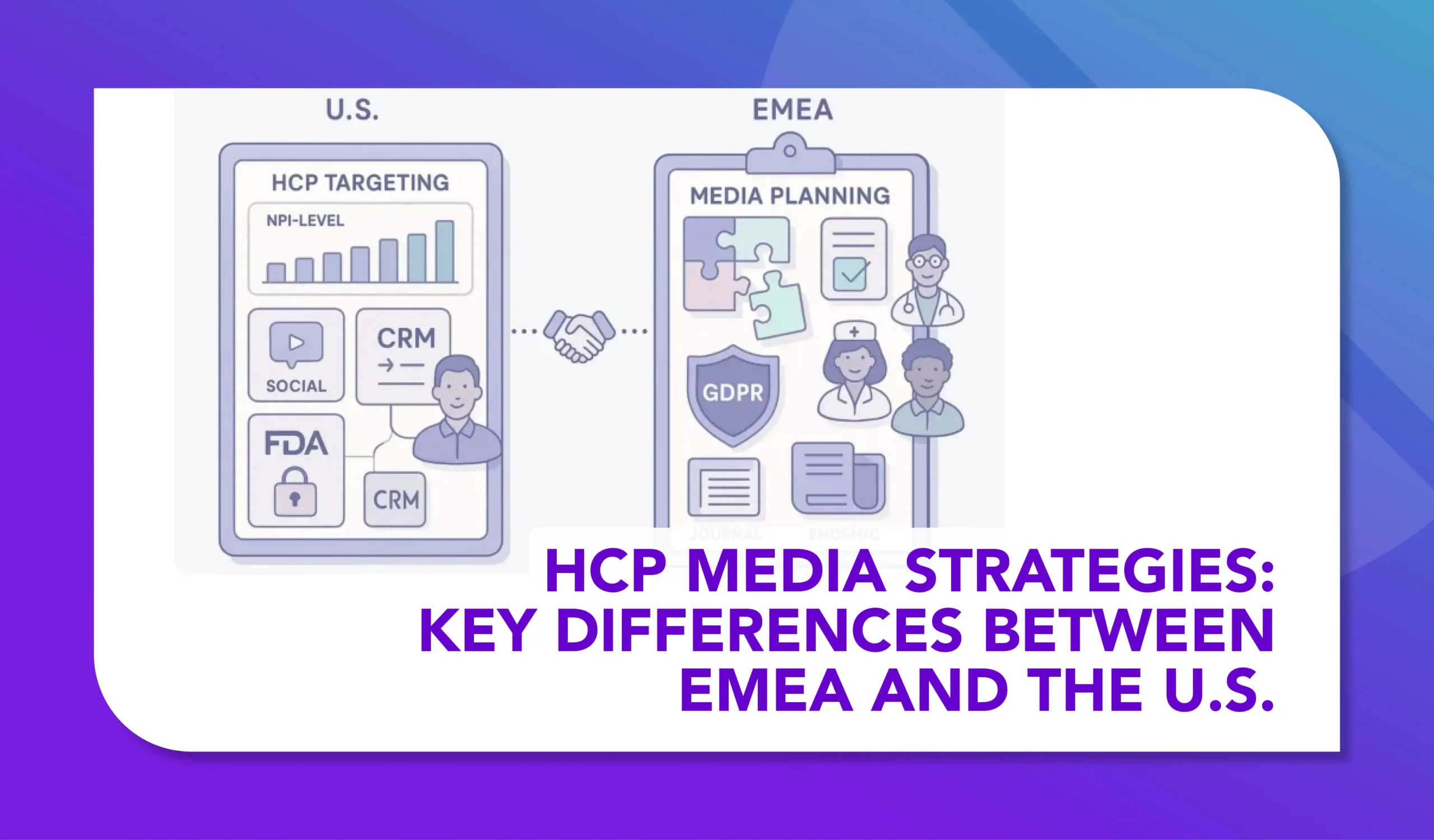
Interested in learning more about HCP engagement? Dive even deeper with this training course on the differences in HCP media strategies in the U.S. and EMEA.