

























Can Pharma Media Build a Common Measurement Language?
Pharma media agency and tech leaders weigh in.


This article is part of solli’s August series exploring Metrics and Measurement.
Marketers today in pharma and beyond are juggling an increasingly long list of media channels, many of which are measured by an individual set of metrics that may or may not be tied to actual impact.
The latest edition of Nielsen’s annual marketing report showed that barely one-third of marketers around the world are currently measuring their digital and traditional media spending holistically. That marked a slight drop from the previous year’s response, which Nielsen suggested could be linked to the introduction of still more channels with incompatible metrics, a reliance on “walled garden” systems with minimal data transparency or shifting privacy regulations, among others.
When asked about the biggest challenges they face in measuring results, the surveyed marketers offered up a lengthy list: a lack of alignment on key metrics, too much data, not enough data, incomparable data, a lack of granularity in available metrics, too many tools, siloed teams and more.
Essentially, that fragmentation means that it can be difficult—if not completely impossible—for marketers to compare results across channels in any meaningful way, leading to blind spots and an overall lack of clarity around media strategy.
In response to those pervasive issues, the push for a unified measurement framework may be reaching a fever pitch. Earlier this year, for example, Coca-Cola pulled back the curtain on a tool it’s been developing alongside Top Line Marketing and Kantar for several years: Universal Media Measurement, aimed at standardizing measurement across all on- and offline channels spanning paid, owned, earned and shared media.
Could the pharma media industry be the next to take a page out of its consumer colleagues’ book and introduce a common currency across omnichannel measurement? And, perhaps more importantly, would marketers be on board?
In a series of interviews with solli, leaders from several health- and pharma-focused agencies and martech developers offered up their musings on the prospect of a unified measurement language in pharma media.
Seeking standardization
There’s broad agreement that measurement is in dire need of a makeover and that pharma media could greatly benefit from some sort of standardization.
“Marketing has become continuous, cross-channel and data-rich, but measurement remains episodic, fragmented and hard to operationalize,” said Jason Brenner, RVP of healthcare and life sciences at LiveRamp. “In the health and pharma sectors, where marketers deal with highly sensitive data and specialized inputs like healthcare claims, this fragmentation is even more painful.”
Still, amid all the potential benefits of a common currency, marketers should avoid becoming too constrained by such a framework.
“Standardization should not come at the expense of innovation,” said Justin Rosen, head of measurement at IQVIA Digital. “Organizations should have the flexibility to differentiate through methodology, insights and execution. The goal is not complete uniformity, but rather a common understanding of what metrics mean and how they relate to one another.”
Kyle Armstrong, VP of platform and publisher partnerships at PurpleLab, shared a similar sentiment, noting that the ideal standardized measurement framework would offer the industry a common foundation rather than eliminating innovation.
“Ultimately, a common framework would give healthcare marketers the confidence to compare channels consistently, allocate budgets based on real outcomes and understand how media influences patient behavior,” he said.
On the topic of innovation, a standardized framework may also play a crucial role as the acceleration of AI-powered technologies in the industry increasingly requires clean, actionable data to run smoothly and effectively.
As Brenner noted, “Without a common measurement language built on a unified identity spine and standardized inputs, we cannot leverage the next generation of AI-enabled measurement.”
He continued, “AI does not eliminate fragmented data; it amplifies it. A common measurement language ensures we have the trusted data foundation required to turn insights into action.”
Common language, different metrics
So, what does the ideal version of measurement standardization look like in pharma media?
Importantly, the experts interviewed were practically unanimous on the need to differentiate between introducing a shared framework vs. applying identical metrics to every channel.
IQVIA Digital’s Rosen, for one, laid out an example in which channel-specific KPIs persist, but are translated into a consistent, broadly understood language describing the audiences reached and business outcomes achieved.
“The value is not in making every measurement approach identical, but in making the intelligence generated from those approaches more interpretable,” he said. “Different organizations will continue to use different methodologies, data assets, ad formats and analytical frameworks to answer business questions. However, stakeholders should be able to align on the underlying meaning of the results.”
Many more of the leaders interviewed also described models that would be tailored both to each client’s business objectives and to the most meaningful metrics for each specific channel.
“We need shared clarity on the ‘job’ of each channel: What is this channel supposed to do, for whom and at what stage of the journey? A TV awareness play and a patient CRM touchpoint aren’t doing the same job—holding them to the same success metric is unhelpful,” said Ashley Mahoney, head of performance marketing at Deerfield Group.
“In today’s marketing environment, it’s important to be high-touch, nimble and agile, which requires defining success at the channel and tactic level, not just the campaign level,” she continued. “You need a granular understanding of what tactical pieces worked, which messaging landed. Acknowledge the inherent limitations of each channel. Build in leading indicators alongside outcomes—in health, the conversion cycle is long and complex.”
Likewise, Michael Sarnoski, VP of analytics at Fingerpaint Marketing, suggested that marketing teams should start with agreed-upon business goals and attributions, then work backwards from there to determine which KPIs are best suited to each channel in play.
“The metrics underneath should differ, and that’s the point,” he said, explaining that an approach that standardizes goals instead of metrics allows each channel to be held accountable for its actual purpose.
Ultimately, as Wendy Emerson, SVP of marketing science at Butler/Till, noted, “By defining the collective outcome, clarifying each channel’s role in advancing it and establishing when decisions about success will be made, marketers can move beyond ‘analysis paralysis.’”
She added, “The goal is not metric uniformity; it is evaluating the right signals at the right time to make better optimization, investment and strategic decisions.”
And when it comes to actually compiling standardized measurement data, LiveRamp’s Brenner outlined a “connected, interoperable data foundation” built around five key features: common identity framework; unified connectivity with minimal data movement; transparent methodology; layered agentic AI; and vertical-specific content.
“Getting closer to a best-in-class standardized measurement framework requires treating data preparation and QA as the primary investment,” he said. “We need to shift from manual data onboarding to AI-driven mapping and orchestration. Furthermore, we must integrate rich customer context, capturing the specific nuances, compliance rules and campaign objectives unique to pharma, so that measurement is actually relevant to the business.”
Achieving alignment
The road to a standardized measurement framework in pharma media will likely be a bumpy one.
On the data front, per Brenner, there are the pervasive issues of walled gardens, differing methodologies, manual onboarding requirements and black-box systems that don’t allow for the transparency necessary in industries as highly regulated as pharma and healthcare.
“It’s critical to have clean data that can be imported into systems and standardized across measurement platforms,” Deerfield’s Mahoney agreed, but added, “Even with perfect data, you still need agreement on what you’re trying to learn. Revisit the strategy and the ask. Better data doesn’t fix a bad or ill-defined question.”
On another note, she pointed to many teams’ practice of simply “[defaulting] to the metrics that are easiest to report”—as opposed to those that may offer the greatest insights.
Indeed, the biggest obstacles may stem from humans rather than technology.
“The technology is already here,” said Armstrong, of PurpleLab, noting that “the bigger hurdle is industry alignment,” as many stakeholders continue to work within their own measurement platforms that limit interoperability and cross-channel comparisons.
Similarly, Fingerpaint’s Sarnoski suggested that “the hardest part” of achieving a standardized measurement framework is getting a diverse array of stakeholders to agree on overarching goals and the channel-specific KPIs that feed into those outcomes.
“But that alignment is also what unlocks everything else,” he said. “Once the north star and the ladder are set, the data gaps and the assumptions you’ll have to make become clear. You can’t solve for those until you’ve defined what you’re measuring against. Get the alignment right, and everything after it gets more strategic.”
Overall, the pursuit of better measurement will depend on breaking down organizational, regulatory and behavioral barriers, not on gathering even more metrics, according to Butler/Till’s Emerson.
“Pharma teams operate with long review cycles, limited creative flexibility, complex data and fundamentally different audience dynamics across patients and HCPs. At the same time, stakeholders often expect the same data to answer very different questions,” Emerson said. “A stronger model starts with upfront alignment: what can be answered, when it can be answered, what evidence is credible and what decision will follow. It also requires clarity about what measurement cannot prove.”
She concluded: “The framework is only as strong as the discipline behind it.”
For more on Metrics and Measurement, click here.
Related solli Training Course:
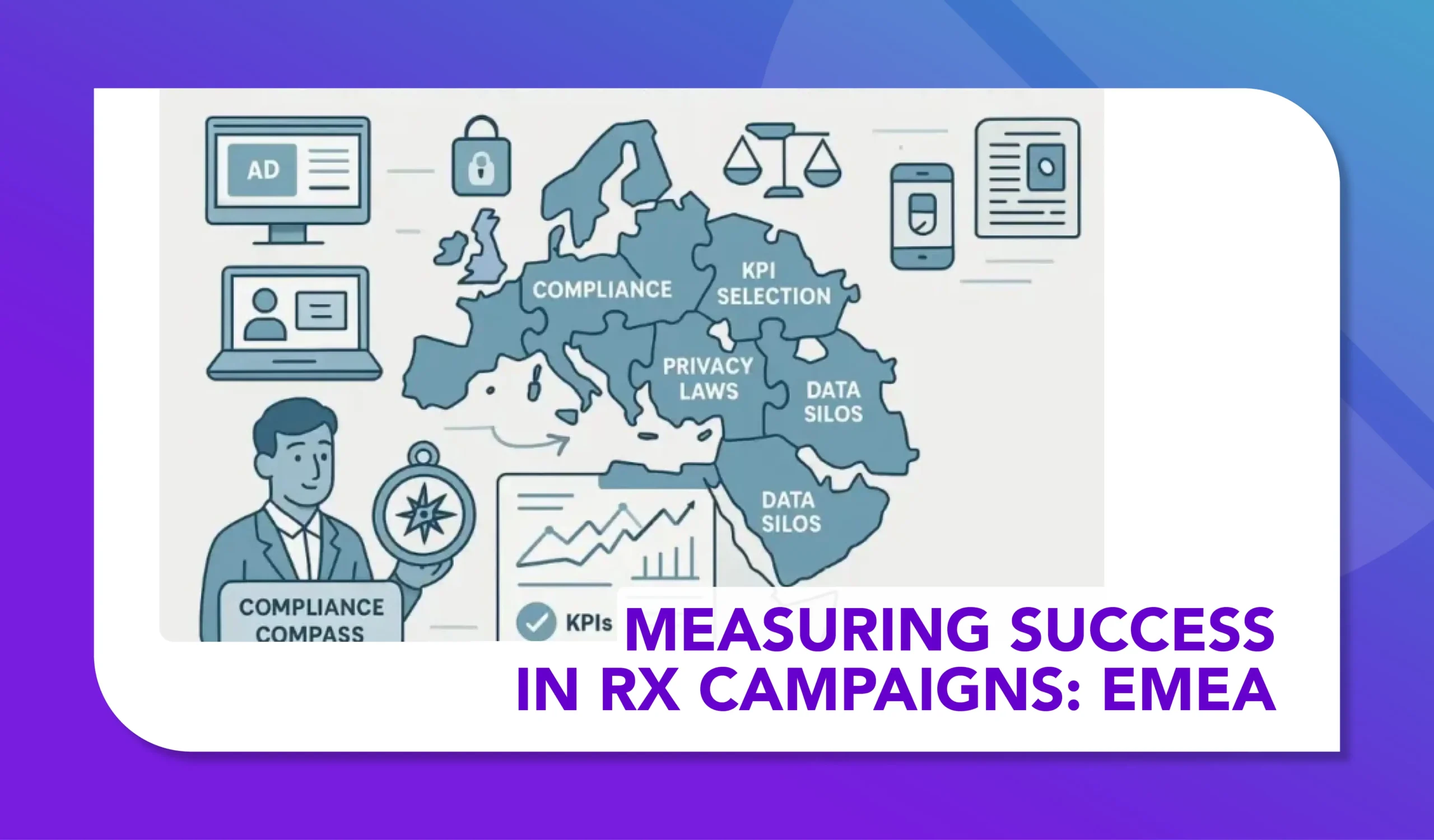
Interested in learning more about global measurement strategies? Dive even deeper with this training course on measuring campaign performance across EMEA markets.