




































Patient Journey Based HCP Targeting
Prioritizing HCPs whose patients are approaching a treatment decision


MedFuse, a healthcare claims data provider, has partnered with analytics consultancy Syneractiv to help healthcare marketers turn patient journey insights into measurable growth through decision science.
An oncology brand faced a smaller competitor gaining share faster than its own growth. To help it defend revenues, MedFuse added a patient readiness overlay to the brand’s existing targeting, identifying HCPs whose patients were approaching a treatment decision within 30, 90, or 180 days. The resulting priorities gave the brand a clearer reason to engage each HCP at the right time. In deployed omnichannel campaigns, prioritized HCPs delivered a reported 5-10% conversion lift over the existing targeting approach and a 10x return on campaign spend.
The Business Challenge
The incumbent oncology brand was facing market-share losses from a much smaller competitor that was gaining ground faster. In a 12-month analysis, the incumbent still held ~90% claims share (TRx), but the competitor grew ~15% year over year versus ~10% for the incumbent. The objective was to defend share while there was still an opportunity to influence new treatment decisions, rather than wait for prescribing by competitors to become an established habit.
The cost of continuing the current plan
In a market where much of the patient pool was already in treatment, competitor gains could become durable share loss if new starts and therapy changes were missed. The analysis found ~500 HCPs adding the competitor versus ~50 moving back toward the incumbent. It also identified 65K prescriptions at risk across 2K declining writers, representing about $2.1 billion in gross revenue exposure. This was the value associated with the at-risk pool, not a forecast that the full $2.1 billion would be lost. Converting just 5% of that modeled exposure would represent approximately $100 million in revenue gains.
Why the current targeting approach leaves a gap
The brand already deployed omnichannel marketing guided by prescribing volume and behavioral propensity models. These models remain useful for identifying likely writers. The gap was that an HCP could have high propensity and little immediate eligible-patient opportunity, while another HCP with a smaller historical book could have several patients nearing a decision. Without an explicit patient readiness criterion, the plan could spend its most valuable contacts at the wrong point in the patient journey.
The patient readiness overlay
Syneractiv leveraged MedFuse open claims data, adding a patient readiness score to the existing HCP list. Recent diagnosis and testing activity, treatment gaps, pathway movement and competitive starts were used to estimate how much of each HCP’s panel may be approaching a treatment decision.
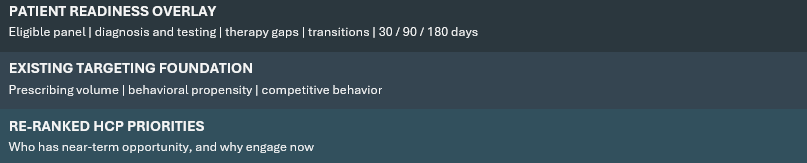
How patient readiness is estimated
Readiness is a pattern across patient journeys, not a single claim or a clinical diagnosis. The model uses line of therapy alongside coded diagnoses, diagnostic and biomarker testing activity, comorbidities that affect treatment suitability, treatment gaps, switches and potential progression markers. For each patient, disease-specific features estimate the probability of an eligible treatment decision within 30, 90 or 180 days. Those patient probabilities are aggregated to the HCP, with panel size and expected opportunity considered alongside prescribing and propensity.
Claims can show coded diagnoses and that a test or treatment occurred, but generally cannot confirm the clinical diagnosis, disclose a biomarker result, establish all eligibility criteria or pinpoint when a decision will occur. The score therefore requires therapy-specific definitions, temporal validation against subsequent starts or switches, and monitoring for claims lag. It is a modeled commercial opportunity signal, not a clinical determination.
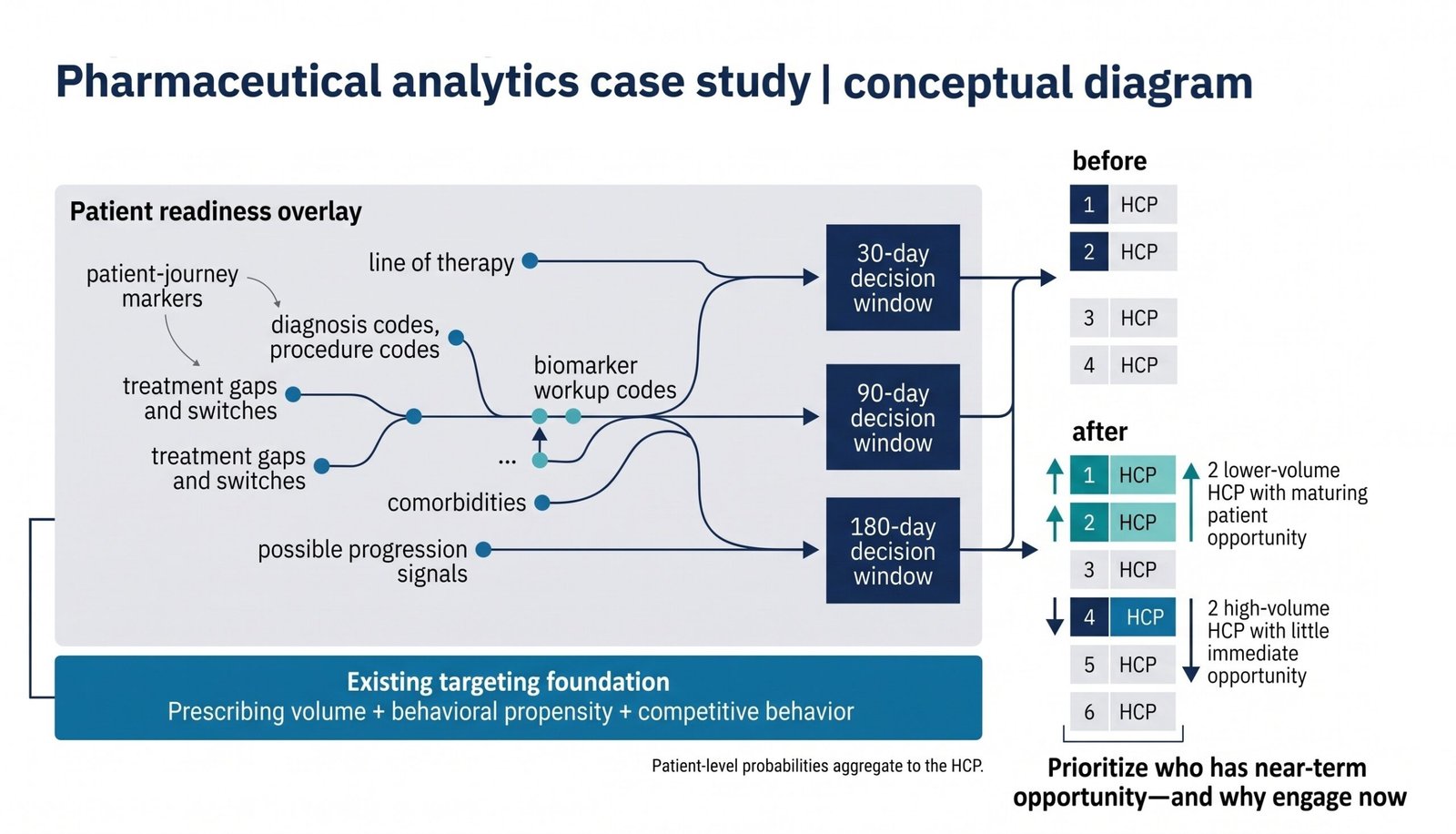
Where the approach extends
Journey characteristics can change by disease. Oncology may emphasize treatment line, biomarker workup and progression; severe asthma may emphasize exacerbations, steroid use and the move toward biologics; lipid management may emphasize treatment intensification and possible statin intolerance before PCSK9 therapy. Where no formal line progression applies, relevant comorbidities, testing recency and care patterns can play a greater role. The same overlay can defend an incumbent brand, as in this case, or help a challenger concentrate limited outreach on near-term openings.
In a separate de-identified PCSK9-class illustration, 2,900 of roughly 41,000 HCPs held 45% of estimated addressable unrealized opportunity, and 62% of those 2,900 were outside the covered field universe. This demonstrates concentration and potential list reordering, not a measured predictive improvement or oncology campaign result.
Commercial impact and proof
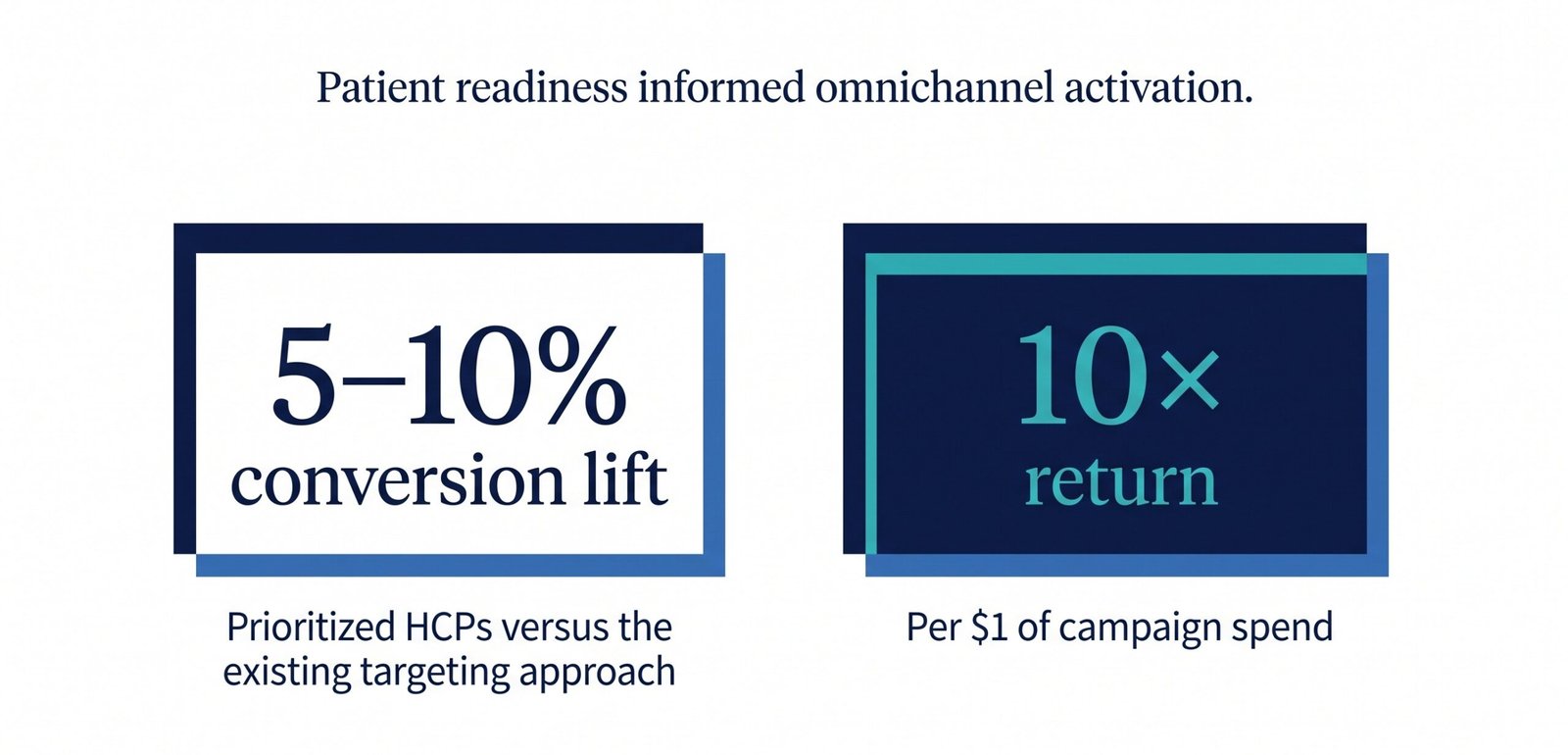
Deployed omnichannel campaigns drove a 5-10% conversion lift range across prioritized HCPs on top of the current targeting approach, yielding a 10x return per $1 of spend.