


























Your Campaign Reached Physicians. Did It Change Anything?
In an era of information overload, the true measure of physician engagement isn't exposure. It's impact.


Healthcare marketers have never had more ways to reach physicians, and the tools keep getting better. But somewhere between the impression and the outcome, something gets lost. Reach and impact aren’t the same thing, and the gap between them is widening.
The programs that truly move the needle don’t just show up in front of physicians; they earn attention through relevance, sustain it through meaningful engagement and ultimately shape how clinicians think and act. The question has shifted from “Did we reach physicians?” to “Did we make an impact?”
Reach has never been easier to buy. Between programmatic display, email, point-of-care networks, social platforms and endless digital touchpoints, healthcare marketers can put a brand in front of physicians almost anywhere. So why does breaking through feel harder than ever?
Because reach and attention aren’t the same thing. A physician can be served your ad and never register it. They can open your email and delete it in three seconds. They can scroll past your content while triaging a packed inbox between patients. The impression counts. The impact doesn’t.
For pharma media buyers, strategists, marketers and agency partners, this distinction is becoming the defining challenge of healthcare professional (HCP) engagement. The metrics that have long defined success—impressions, opens, clicks and unique reach—measure exposure. They don’t measure whether a physician understood your message, retained it or changed how they think about a treatment.
This article unpacks why that gap matters and how to close it.
Why physician attention is harder to earn than ever
Physicians aren’t paying less attention to professional education. They’re simply forced to be far more selective about where they focus their attention.
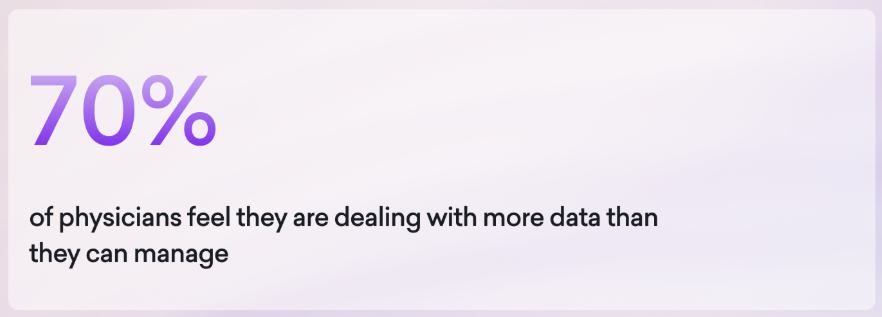
According to Medical Economics (2025), 70% of physicians feel they are dealing with more data than they can manage. That’s not a content consumption problem. It’s a signal that relevance and precision now determine whether professional information earns a physician’s attention or gets lost in the noise.
The amount of information physicians are expected to absorb continues to grow. New treatments are introduced. Clinical evidence evolves. Guidelines change. At the same time, the amount of time available to process that information hasn’t changed.
The challenge isn’t motivation; most physicians genuinely want to stay current. The challenge is bandwidth. And if volume is the problem, relevance and repetition are the answer.
Physicians don’t need more content. They need the right content, delivered multiple times, from sources they trust, in a format that respects their time.
Exposure builds recall and prescribing confidence
Relevance earns attention. Repetition turns that attention into learning.
Physicians don’t make prescribing decisions after a single touchpoint. They prefer engaging with multiple, trusted pieces of educational content before they feel confident enough to act, and the data is remarkably clear on how many interactions it takes.
Two-thirds of physicians want to see three to six pieces of educational content on a clinical topic before implementing it into practice. Another 23% prefer to see seven or more pieces of content.
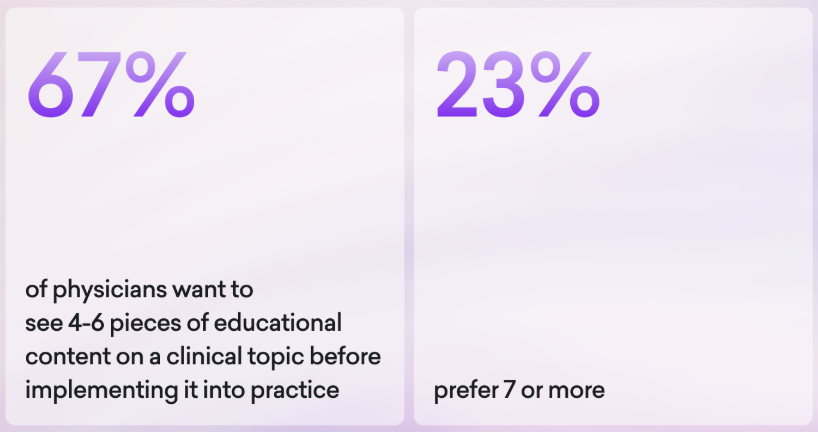
Confidence isn’t built in a single interaction. It accumulates through repeated, trusted exposure over time, and recall follows the same pattern.
Repeated exposure reinforces key information about a drug’s safety and efficacy, and physicians become significantly more likely to remember important takeaways after encountering educational content multiple times. After only one or two exposures, just 6% of physicians report recalling key brand information.
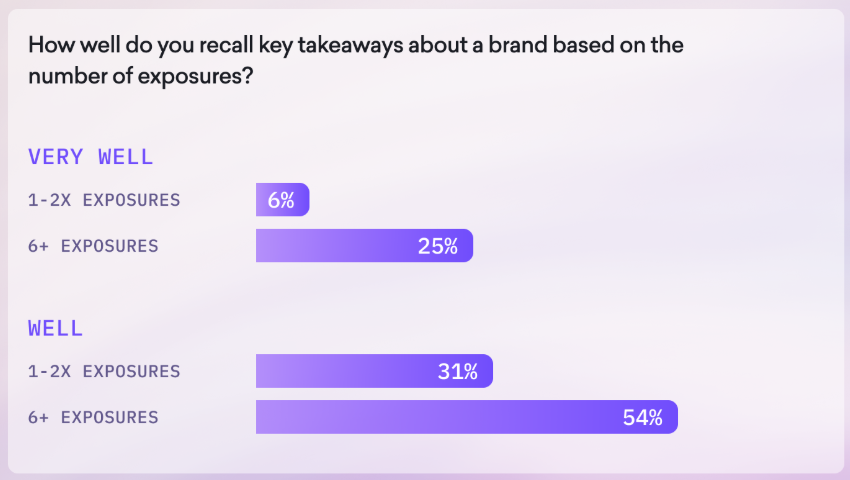
The difference between a forgettable campaign and a memorable one often comes down to how many meaningful opportunities a physician had to engage, not how many times they were technically reached.
Physicians themselves reinforce that point. More than 90% say repeated exposure to branded treatment information helps them retain key drug information, including safety and efficacy data.
Physicians pay attention to content that helps them deliver better care, validated by peers they trust, in a format they can absorb in the few minutes they have available. Get those elements right, and you’ve earned a place in a very crowded day. Get them wrong, and you’ve spent budget on an impression that never landed.
Why peer-to-peer communities change the equation
If physicians learn through repeated, relevant interactions, the environment where those interactions happen matters just as much as the content itself.
On a physician-only platform like Sermo, your content appears within an environment physicians already trust and actively use to exchange clinical perspectives, discuss patient challenges and learn from peers. Rather than interrupting a physician’s day, it becomes part of an ongoing professional dialogue.
When 91% of physicians rate physician-only platforms as more credible than general social media, the environment itself adds weight to your message.
A post that sparks discussion, poll participation or video engagement creates the kind of repeated interaction that builds recall and confidence. That’s something reach alone can never deliver.
Beyond reach: measuring what actually matters
If success can’t be measured by impressions alone, what should marketers measure instead? The answer is impact: engagement depth, knowledge shift and intent to act.
The appetite for engagement is real. According to Sermo’s HCP Sentiment research, 57% of physicians seek educational content from medical affairs teams on a monthly or weekly basis. The opportunity isn’t simply getting in front of physicians. It’s determining whether your program actually influenced the way they think, learn and ultimately practice medicine.
That’s where traditional media metrics begin to fall short. Impressions, clicks, opens and reach can tell marketers how many physicians had the opportunity to see a message. They cannot tell you whether that message increased awareness, improved confidence or changed behavior.
As Casey Salvetti, VP of revenue analytics & strategy at Sermo, explains, “Reach tells you who had the opportunity to see your message. Impact tells you whether your message actually influenced treatment behavior. That’s the distinction marketers need to be measuring.”
Sermo evaluates programs through dedicated Program Impact Studies designed to answer exactly that question. By measuring shifts in awareness, diagnostic confidence, treatment familiarity and prescribing intent, these studies provide a deeper understanding of campaign effectiveness than media metrics alone ever could.
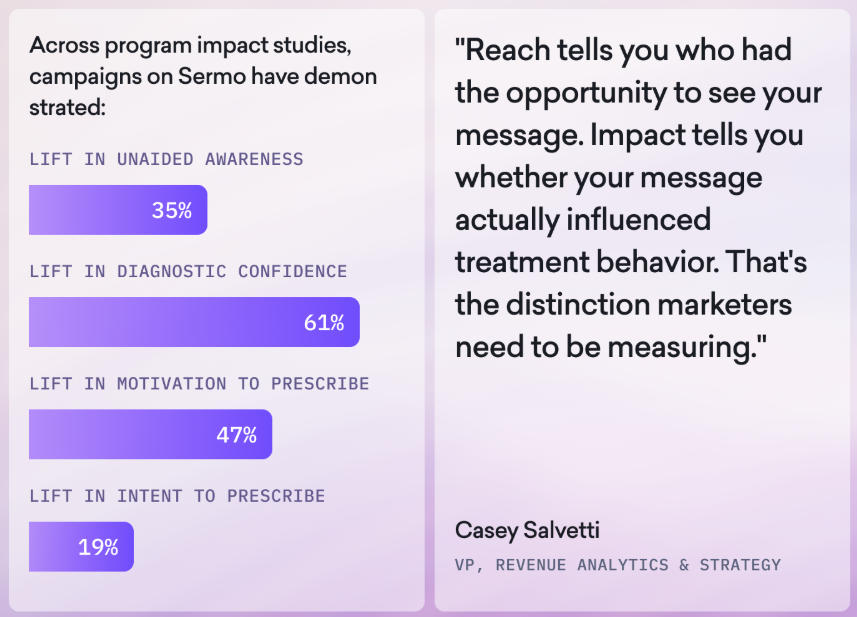
Across Program Impact Studies, campaigns on Sermo have demonstrated measurable lifts in unaided awareness, diagnostic confidence, motivation to prescribe and intent to prescribe. Those benchmarks tell a much richer story than reach alone. They show that meaningful physician engagement doesn’t simply generate activity. It changes perceptions, strengthens confidence and moves physicians closer to action. That’s the difference between measuring campaign performance and measuring campaign impact.
What impact looks like in practice
One recent campaign on Sermo demonstrates what happens when marketers move beyond measuring exposure and begin measuring outcomes. For a treatment indicated for IBS-D, a Program Impact Study compared physicians exposed to the campaign with a matched holdout group who were not exposed. The goal wasn’t simply to understand who saw the campaign. It was to determine whether the experience actually influenced physician knowledge, confidence and prescribing behavior.
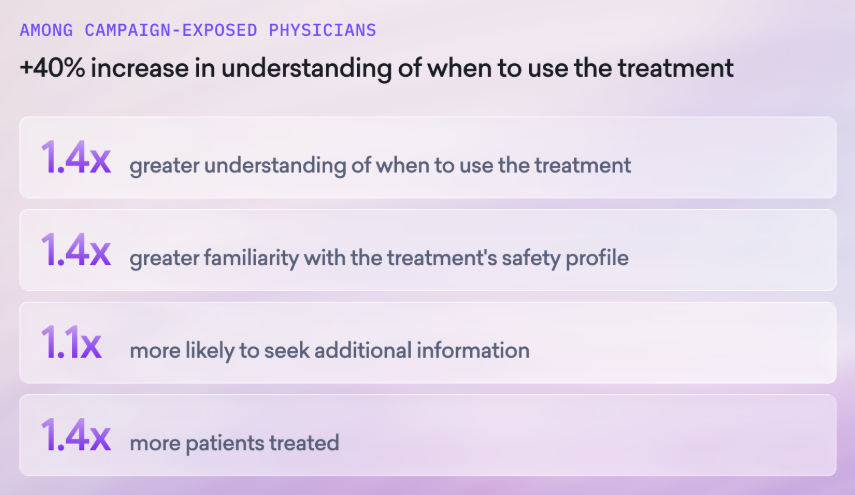
The results were clear. Physicians exposed to the campaign demonstrated stronger understanding of when to use the treatment, greater familiarity with its safety profile and increased interest in learning more about the therapy compared with physicians who were not exposed. Most importantly, they were also treating more patients with the product, demonstrating that meaningful engagement translated into measurable behavioral change.
Compared with the holdout group, campaign-exposed physicians were:
- 1.4x more likely to understand when to use the treatment
- 1.4x more familiar with the treatment’s safety profile
- 1.1x more likely to seek additional information
- 1.4x more likely to treat patients with the therapy
These outcomes reinforce a simple but important reality: Physician engagement is valuable not because it generates clicks or impressions, but because it can increase understanding, build confidence and ultimately influence clinical decision-making. Reach told us who had the opportunity to see the campaign. The Program Impact Study revealed what the campaign actually accomplished. Together, they provide a much more complete picture of success.
The bottom line
Reach gets you in the room. It doesn’t guarantee anyone is listening, learning or leaving more confident than when they arrived.
As physician attention becomes increasingly scarce and information overload continues to intensify, the brands that outperform won’t necessarily be the ones that buy the most impressions. They’ll be the ones that earn relevance, sustain engagement and measure what those efforts actually achieved.
For media buyers, strategists and marketers, that means expanding the scorecard. Continue measuring reach, but measure it alongside engagement depth, knowledge retention, confidence and intent. Ask whether your content was relevant enough to be remembered, valuable enough to earn another interaction and impactful enough to influence physician understanding, not simply generate activity.
Because the question is no longer whether you can reach physicians. It’s whether you can make an impact—and whether you can prove it.
Ready to measure what matters? Connect with the Sermo team to learn how Program Impact Studies can help you move beyond measuring opportunities to see a message and start measuring meaningful changes in physician awareness, confidence and prescribing behavior.