

































The Real Cost of Asking for ‘More with Less’
The push for efficiency is reshaping margins, talent and the client-agency bargain.


This article is part of solli’s July series exploring The State of the Agency.
I spent more than a decade in media agencies working with pharma companies, locally and globally, and one tension was always there: Procurement and brand marketing were often looking at the same agency relationship from completely different angles.
Agencies have played their part in creating the pressure. During RFPs, they price aggressively to win, but once the celebrations are over, the account still has to make money. Brand teams are expected to deliver against the promise, local leaders are asked to build the team with little room to manoeuvre and global leaders have to prove the win was worth more than the headline.
None of that is new. What has changed is the speed of the technology story. AI and automation have created the impression that agencies should now be able to produce more, move faster and charge less—almost immediately. I have a great deal of sympathy for the agency leaders trying to make those numbers work.
The big questions are what “doing more with less” means now, what it could mean in a few years and what the industry stands to gain—or lose—if it gets the transition wrong.
The phrase itself is familiar enough to feel harmless. Every agency leader has heard some version of it, and every client has had to ask for it. Margins tighten, scopes expand, deadlines move forward and a team is expected to absorb the difference.
What makes the current moment more serious is that technology has given the demand a new kind of credibility. Once an agency presents AI as a productivity engine, it becomes reasonable for a client to ask where the productivity is showing up. Faster reporting should mean fewer hours. Automated content should mean lower production costs. Better workflow tools should mean smaller teams.
The spreadsheet logic is compelling, but the operating reality is much less tidy.
The old bargain is starting to break
For years, agency economics have depended on a difficult bargain. Agencies compete aggressively to win business, often on pricing that assumes future efficiencies, scale benefits or staffing leverage. Once the work begins, leaders have to create a viable delivery model from a commercial promise that may already have removed much of the available margin.
The consequences travel quickly through the organisation: The local market is asked to deliver against a global fee. The global team points to the strategic importance of the win. The account lead is expected to find savings without weakening the client experience. Junior and mid-level roles become the easiest variables to adjust because technology, property and leadership charges are harder to move.
Clients are not naïve about this. Many have lived through accounts that began with senior attention and gradually migrated toward more junior delivery. They have seen promised platforms arrive late, operate unevenly or require significant manual work behind the scenes. They have heard claims about automation and its ability to rapidly accelerate operations before.
But speed often merely shifts the bottleneck, rather than removing it completely. An MLR team that previously reviewed 10 assets may now face 50 modules and hundreds of possible combinations. Every claim still needs support, every execution needs an owner and every change must be traceable.
Productivity improves only when the review model, content architecture and governance evolve with the technology. Otherwise, the industry has automated production and industrialised approval pressure.
This is where “more with less” can become “more for the sake of more”: More dashboards. More versions. More insights. More audience segments. More optimisation cycles. More reporting moments.
The capacity released by technology is often filled before anyone has established whether the additional output actually improves the decision.
So when agencies now say AI will transform productivity, procurement teams are entitled to ask what changes in the commercial model.
The problem is timing. Pharma wants the benefits of a transformed agency model, but many agencies are being asked to fund the construction of that model through savings that are supposed to emerge only after it exists. Much of the efficiency being discussed has yet to become dependable, repeatable and embedded across the full workflow.
Tools can accelerate individual tasks, yet the broader operating system remains fragmented. Clients want AI to reduce headcount, but agencies still need people to build the systems that make those savings possible.
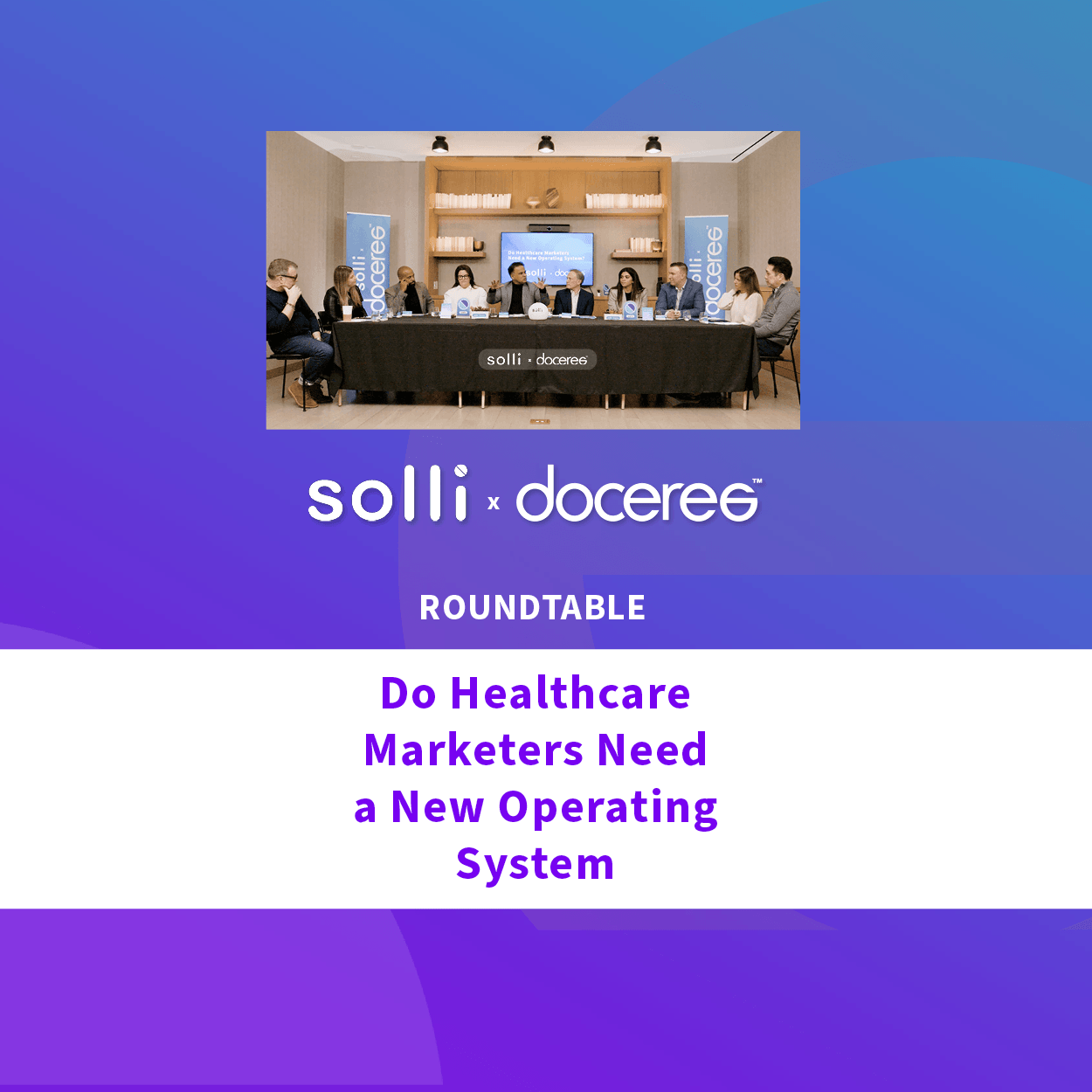
During a recent roundtable discussion among senior healthcare media leaders convened by solli, one participant described the client pressure with unusual candour: “How many FTEs can we drop?” The same speaker linked that question to a push to reduce so-called nonworking media costs.
That language reveals the issue more clearly than most formal statements ever could.
The “working” part of media is generally the part that reaches the market. The people planning it, interrogating the data, negotiating the investment, navigating MLR, managing risk, connecting systems and explaining the results are placed in another category. Once the money is divided that way, the second category always looks available for challenge, and AI has sharpened that challenge.
The uncomfortable question for agencies
There has long been a risk of agencies using complexity as a shield, where some roles exist only because systems are poor, teams may be larger than they need to be or certain reporting structures persist out of familiarity rather than utility.
AI can and should expose those weaknesses.
It would be disingenuous for agencies to present every threatened task as high-value strategic work. Some work will disappear, some roles will be redesigned and some operating models will become difficult to defend—and clients should push for those changes.
The stronger agency argument is not that headcount must remain untouched. It is that staffing decisions should follow a clear understanding of where value is being removed, where it is being created and what the transition requires.
The best use of a saved hour may be a lower fee. It may also be better analysis, more experimentation, stronger governance or earlier involvement from senior talent. The commercial answer will differ by account; what matters is that the answer is explicit.
One speaker in the aforementioned panel discussion captured the internal tension: “Procurement wants to see savings; marketing, commercial, medical wants to see results.”
That gap has always existed. AI widens it because each side can point to the same technology and reach different conclusions:
- Procurement sees a reduction in effort.
- Marketing sees an opportunity to improve output.
- Medical sees additional governance risk.
- The agency sees an investment programme.
All four can be right. The challenge is that only one of those perspectives tends to fit neatly into the annual savings target.
The talent pipeline nobody has priced
The most important consequence may not appear in the next scope negotiation and may in fact take years to become visible.
Media agencies have traditionally developed expertise through apprenticeship. Junior staff build plans, check data, sit through reviews, reconcile inconsistencies and learn how decisions are made. Much of that work is repetitive, and some of it is exactly what AI should remove, but it’s also where judgement begins.
If entry-level tasks disappear, agencies will need a new way to teach people how the business works. There is no automatic path from using an AI tool to becoming a trusted strategist. Judgement grows through exposure to mistakes, trade-offs and difficult decisions.
The industry may be heading toward an hourglass workforce: a smaller junior base, a thin middle and an expensive group of senior specialists at the top, with technology filling some of the space between them.
That model looks efficient until experienced people leave.
Agencies will need to redesign training around the work that remains. Junior staff should spend less time formatting reports and more time questioning them. They should be brought into optimisation, scenario planning and client decisions earlier. Senior people will need to teach reasoning rather than simply review output.
The expectation placed on talent is already expanding. One participant in the solli roundtable said a person can no longer “just be a media planner” —they need to understand activation, platforms and the technology that powers the work so they can operate “bigger and better and faster.”
That all requires capacity. If every efficiency is extracted immediately through a lower fee, the space for development disappears with it.
The client may save money this year but inherit a weaker talent market later. Is that the client’s problem? Yes. But I imagine only the best will see it as their responsibility to contribute to fixing it.
Who gets the value?
The debate over doing more with less, with or without AI assistance, is also a debate over who owns the gain.
When a tool allows an agency to complete work with fewer hours, the client can reasonably claim the savings. But the agency may argue that it funded the platform, training and integration, as the holding company expects margin improvement, the technology provider charges for access and employees are expected to produce more.
That is why the industry needs a more mature commercial conversation. Each account should identify which activities will stop, which will improve and which new capabilities will be funded. The parties should agree when transformation costs end, how savings are measured and who owns the infrastructure created along the way.
Ownership is especially important. If an agency builds a workflow around a client’s brand rules, claims history, data and approval processes, who retains it when the relationship ends? Can the agency reuse the underlying architecture elsewhere? Who maintains it? Who carries responsibility when a model changes or produces an unexplainable recommendation?
These aren’t new questions brought about only by the rise of AI. They’re contract questions, operating questions and risk questions, but they may be answered in new ways as technological advancements usher in a new wave of efficiencies.
What getting it right looks like
A healthier model would begin with honesty on both sides.
Agencies should acknowledge where AI genuinely reduces effort and allow that reduction to affect pricing over time. They should stop presenting every tool as a premium layer and every role as irreplaceable. They should explain which investments are temporary, which capabilities are reusable and where the client will see measurable gains.
Clients should resist the temptation to treat a technology licence as instantly removable labour. They should ask whether the broader workflow can support the efficiency being promised, and they should decide whether released capacity should be returned as savings, reinvested in performance or shared between the two.
Both sides should stop using FTE reduction as the first proof that transformation is working.
The better proof may be a campaign that changes direction in days instead of months. It may be a content system that produces fewer assets with more relevance. It may be media waste removed from a large budget. It may be a team that spends less time gathering information and more time making decisions.
The agency model will become leaner. Some parts of it deserve to: Roles built around preventable friction will struggle to survive. Manual production will contract. Commercial structures based almost entirely on bodies and hours will become harder to justify.
Yet the industry still needs people who can understand the patient, challenge the data, navigate the regulation, manage the risk and tell a client when the machine’s answer is wrong.
A cheaper agency is easy to design in a spreadsheet. Building a better one is where the real value is found.
For more on The State of the Agency, click here.
Related solli Training Course:
Interested in learning more about the evolution of pharma media in recent years? Dive even deeper with this training course on the shifting strategies and priorities in the industry over time.