




















What Claude Science Means for Pharma Media
When AI moves from chatbot to industry workbench, the moats shift.

Anthropic’s launch of Claude Science is interesting not just because it gives scientists a new AI workbench, but also because of what it says about where foundation model companies are heading next.
We already knew that AI can help scientists. The real shift here is that Anthropic is no longer simply renting the model and letting others build the vertical workflow layer. Claude Science bundles literature search, Jupyter, R, cluster terminals, specialist scientific databases, computational workflows, citation checks and auditable outputs into one product experience. Anthropic says the tool is in beta for Claude Pro, Max, Team and Enterprise users, with more than 60 curated skills and connectors across areas such as genomics, proteomics and cheminformatics.
That raises an uncomfortable but useful question for pharma media: What happens if the next vertical is not “science” in the broad sense, but HCP information, patient education, treatment pathways, medical affairs or even health media planning?
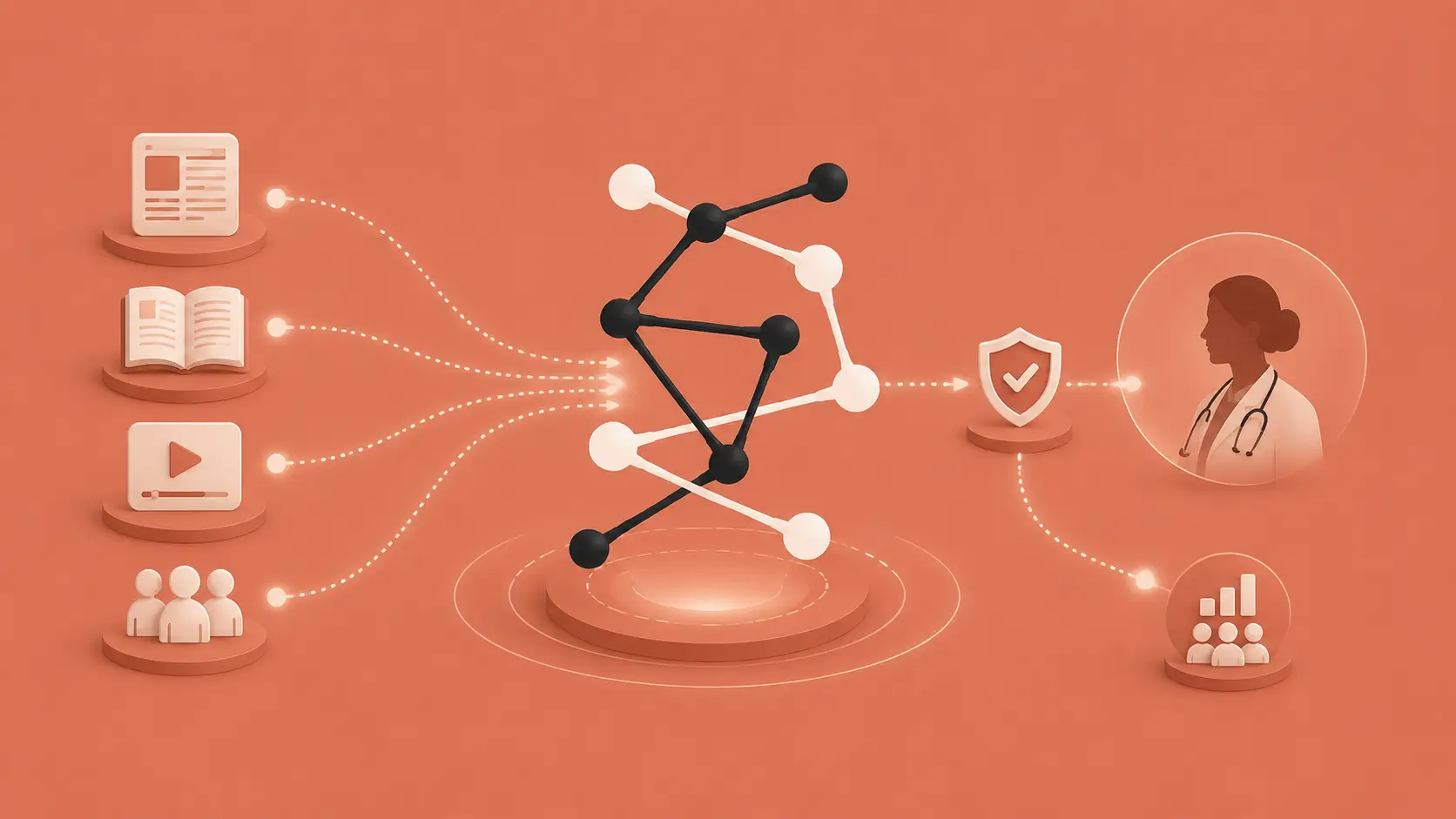
Imagine Claude Health, Claude HCP or Claude Patient: not another chatbot with access to medical information, but a healthcare-specific workbench built around evidence, workflow, compliance and decision support. It would not need to become a “media owner” in the traditional sense. The more interesting scenario is that it could become the specialist layer through which HCPs, patients, medical affairs teams or marketers interpret evidence, plan next steps and decide which sources are worth trusting.
From destination to decision layer
For the last two decades, pharma media has largely been organised around destinations and audiences: verified HCP publications, email newsletters, professional portals, patient education sites, congress media, programmatic inventory, endemic display, sponsored content and data-led targeting.
In an AI-mediated environment, the destination becomes less important than the decision layer.
In recent months, with numerous AI launches from health media owners—like Medscape AI, Healio AI, epocrates, and Healthline AI to name just a few—we are increasingly seeing clinicians’ media usage shift to more conversational formats. An HCP may accelerate this by no longer starting to look for answers by visiting a publication, searching PubMed, checking three guideline sites and opening a newsletter. Instead, they might ask an agent, “What has changed in second-line treatment for this patient type?” or “What is the practical difference between these mechanisms?” or “Summarise the latest congress data that might affect my prescribing discussion.” Patients may do the same: “What should I ask my doctor about this treatment?” or “Explain the risks in plain English.”
This ongoing shift doesn’t remove the need for accurate and regulated information, but it does change how information is discovered, assembled and trusted.
Essentially, if AI agents increasingly become the interface, pharma marketers will need to think less about where ads can be placed and more about which trusted inputs inform the agents’ answers. That doesn’t mean gaming the model, which would be an unsafe and commercially reckless prospect in healthcare. Instead, the real opportunity lies in making high-quality, compliant information more available, more structured, more attributable and more useful.
That shift is already visible on the commercial side. Health AdTech companies such as Doceree and DeepIntent are beginning to connect their intelligence platforms with LLM environments such as ChatGPT and Claude, so users can access proprietary data, planning intelligence and decision-support tools closer to the point of query. In other words, the value is moving from standalone platforms toward intelligence that can be surfaced inside the workflows where decisions are increasingly made.
This creates a new role for HCP media owners: They can become verified context providers, and their editorial, KOL, congress, education and audience data assets can help shape a more trusted information ecosystem—not because they own traffic, but because they own context and relationships.
The same is true for medical publishers, congress platforms, specialist communities and data companies. Future value may sit in being cited, queried, licensed, integrated, permissioned and measured, rather than merely visited.
The first-order impact of agentic AI’s arrival is therefore not a collapse in pharma media spend, but a rerouting of attention. The weak parts of the market—generic SEO content, thin traffic aggregation, undifferentiated HCP newsletters, open-web targeting that cannot prove quality and media products whose main value proposition is “we have the pageviews”—are exposed, while the stronger parts become even more important.
The moats are not where some people think they are
When it comes to defining those strengths, the most defensible pharma media businesses will not be the ones with the largest archives of generic medical content. Large language models are very good at compressing generic content; they are less good at replacing trust, permissions, workflow, identity, editorial judgement and regulated context.
For HCP publications, for example, the moat is not simply content volume. It is verified professional relationships: knowing who the reader is, what specialty they practise, what they have permissioned and engaged with over time and why they trust the publication. It’s the ability to convene credible voices, interpret evidence, curate what matters and maintain editorial standards in a market where inaccurate health information carries real consequences.
For patient publishers and communities, the moat is similar but more sensitive: trust, lived experience, moderation, condition-specific understanding, consented relationships and the ability to communicate without overstepping into promotion or medical advice.
For adtech companies, the defensible layer isn’t just the pipes. It is permissioned identity, data collaboration, measurement, clean-room capability, interoperability and the ability to connect signals without exposing personal information. (That’s why Publicis’ signed agreement to acquire LiveRamp is such an important development for the industry. Publicis says LiveRamp connects more than 25,000 publisher domains and 500-plus technology and data partners, and the transaction is explicitly framed around data co-creation for the AI and agentic era.)
In other words, across the pharma media landscape, the value of data is rapidly increasing—provided the data is consented, high-quality, interoperable and usable inside the workflows where agents operate.
What’s vulnerable, and what’s valuable?
Amid these shifts, several parts of the current pharma media stack are vulnerable.
Basic disease-state explainers will become abundant. Generalised treatment summaries will be easy to generate. Low-value content syndication will be harder to defend. Broad contextual targeting will become less differentiated. Campaign reporting that stops at impressions, clicks and viewability will feel increasingly inadequate.
Media plans built around reach alone will come under pressure, especially where audience quality is weak or opaque. If an AI layer can answer an HCP’s question directly, then a publisher’s ability to attract a transient visit becomes less valuable than its ability to demonstrate authority, trust and influence.
This doesn’t make media irrelevant—it makes lazy media irrelevant.
The market will still need awareness, education, launch sequencing, peer influence, behaviour change, patient activation and measurement. Several assets will therefore become significantly more important:
- Authenticated HCP identity: In an agentic world, knowing that a cardiologist, oncologist, dermatologist or pharmacist is engaging is not a targeting convenience; it is the basis of relevance, compliance and measurement.
- Consented first-party data: Data collection will go deeper than just email addresses to encompass longitudinal behavioural signals, declared interests, specialty, geography, treatment focus, event attendance, content engagement and permissions.
- Expert editorial brands: As synthetic content becomes cheap, recognised human judgement becomes premium. HCPs will still want to know which sources are credible, which experts are worth listening to and which developments deserve attention.
- Regulatory-grade workflows: MLR review, substantiation, version control, claims management, audit trails and risk balance aren’t glamorous, but they become critical when content may be ingested, summarised or redistributed by agents.
- Measurement that connects exposure to outcome: The winners will be able to show not just delivery, but also quality of engagement, incremental reach, script-lift proxies, referral behaviour, patient-support enrolment, formulary influence or other meaningful signals.
- Integration into workflow: The closer a media or data company is to the moment of clinical, commercial or patient decision-making, the harder it is to displace.
The practical takeaway
The most interesting scenario is not that Anthropic launches a pharma ad network. That feels unlikely, at least in the near term. More plausible is that foundation model companies will build trusted healthcare workbenches for specific user groups: scientists, clinicians, medical affairs teams, field teams, patients, carers or payers. Once those workbenches exist, they’ll become new distribution layers, and they’ll need content, data, identity, permissions, compliance tooling, citations, medical review, measurement and integrations.
In that scenario, the businesses most at risk are those that believe their moat is the website, the newsletter or the ad unit. The businesses with opportunity are those that understand their moat is the trust graph underneath: the verified audience, the data permissions, the editorial credibility, the expert network, the compliance infrastructure and the ability to prove impact.
Pharma media companies should not respond to Claude Science with panic, but rather with a sharper inventory of their defensible assets:
- What data do we have that a foundation model company cannot easily recreate?
- Which relationships are permissioned, verified and active?
- What content is genuinely authoritative rather than merely abundant?
- Where do we sit in the HCP or patient workflow?
- Could our content be safely structured, licensed or integrated into agentic environments?
- Can we prove that our media changes understanding, intent or behaviour?
- And, perhaps most importantly: If an AI agent becomes the front door to health information, why would it trust us?
The next era of pharma media will not be won by pretending AI is just another channel, nor will it be won by assuming the model companies will eat everything. The more interesting answer is somewhere in the middle, since AI compresses generic information, but it amplifies the value of trusted, permissioned, regulated and measurable inputs.
For pharma media, the moat will not be the content alone. It is the right content, connected to the right identity, governed in the right way, delivered in the right context and measured against something that matters.
That’s not a doom-and-gloom forecast. It’s a reset. And for the companies that have spent years building trust, data and specialist relationships, it may be a very good one.