





















What Does a Pharma Media Agency Look Like in an Agentic AI World?
Don’t worry: There’s still plenty of room for humans in the loop.

This article is part of solli’s July series exploring The State of the Agency.
In the span of just a few years, what was once a moderate stream of developments in artificial intelligence technology has accelerated into a veritable deluge, shaking up and completely overhauling entire industries in the process—and pharma media has been far from immune.
Leading the charge since the start of the decade are large language models like OpenAI’s ChatGPT and Anthropic’s Claude, as well as other generative AI tools that can rapidly scan massive amounts of data to churn out text, images and videos at a user’s whim.
Hot on GenAI’s tail, however, and with the potential to have an even more radical impact, is agentic AI.
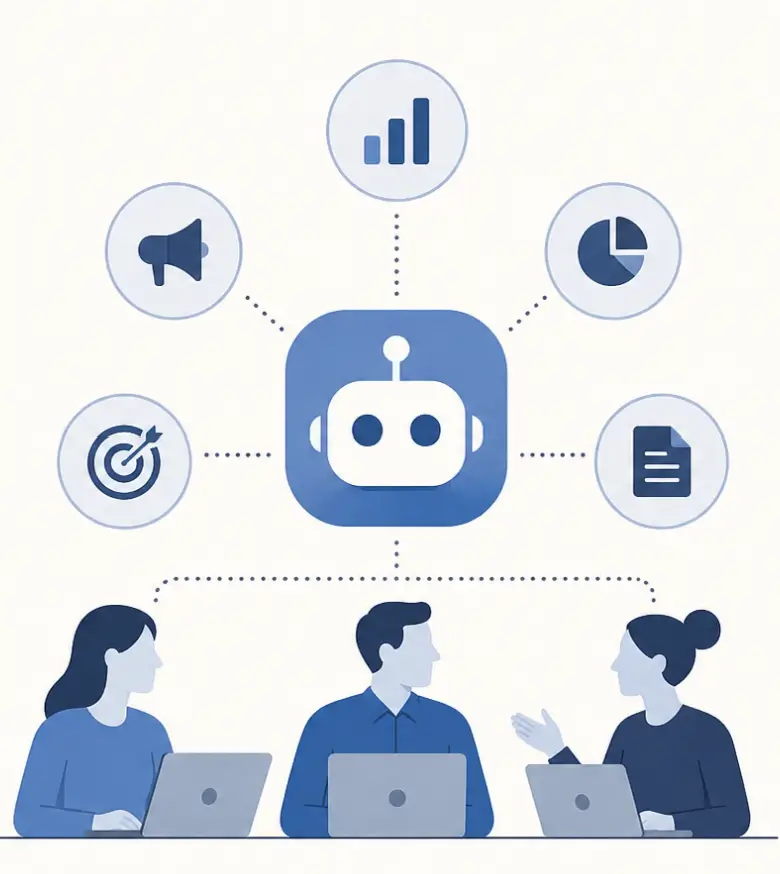
If GenAI is a groundbreaking tool in the palm of a human hand, agentic AI is an earth-shattering system that wields that tool and requires far less hand-holding to do so. Whereas LLMs like ChatGPT respond to specific prompts, AI agents are designed to work more autonomously, executing entire strings of actions, reaching across teams and adapting to new information in real time in pursuit of a stated goal.
A truly agentic world, then, sees AI working side-by-side with humans—and with fellow agents—rather than waiting for their next command. Like generative AI, agentic tools can vastly reduce the manual labor required to dig through mountains of data and therefore free up human workers for more complex, higher-value tasks; unlike their GenAI brethren, agents can keep going without waiting for further instructions, automatically deploying those findings to support specific business operations in their assigned remit.
Predictably, that’s better for business: As of a 2025 McKinsey report, around three-quarters of companies had deployed copilots, chatbots or other GenAI solutions, but more than 80% of them said those initiatives had made no material contribution to their earnings. The report suggested instead that agentic AI is the key to unlocking the full business potential of AI, as agents “supercharge operational agility” with their parallel processing, adaptability and 24/7 availability.
The agentic agency
So, what could that agentic world look like for pharma media?
The industry is particularly ripe for an agentic overhaul, as the technology is especially suited for complex, high-stakes environments with cross-functional teams and where regulatory requirements can be baked into agents’ operations from the start.
Many in the industry are already diving in headfirst, with agentic AI at the core of new pharma commercialization-focused platforms from Doceree and Axonal. At the agency level more broadly, Publicis Groupe is among those investing heavily in AI, including through its acquisition of LiveRamp, longstanding partnership with Microsoft and more.
Eversana, too, is on board. The life sciences-focused agency boasts an in-house AI Accelerator program that’s led by Faruk Capan, Eversana’s chief innovation officer and founder of Eversana InTouch, and dedicated to developing new AI tools for pharma commercialization.
Among its offerings so far is the AI Agency platform, unveiled around this time last year. Created in collaboration with Google Cloud, the platform links together a fleet of AI agents that, together, can automate around 80% of the pharma marketing process, from strategy development and compliant content creation to omnichannel activation and performance analytics.
In an interview with solli alongside Dave Leitner, head of media at Eversana InTouch, Capan explained how, early on in Eversana’s AI journey, the agency realized that the typical strategy of deploying one-off tools to solve specific problems wouldn’t work.
“We quickly learned that if you’re going to start to build these things all separately, in the long term you won’t get the efficiency, you don’t get the results that you want,” he said. “So we kind of rebuilt our whole workflow as an agency.”
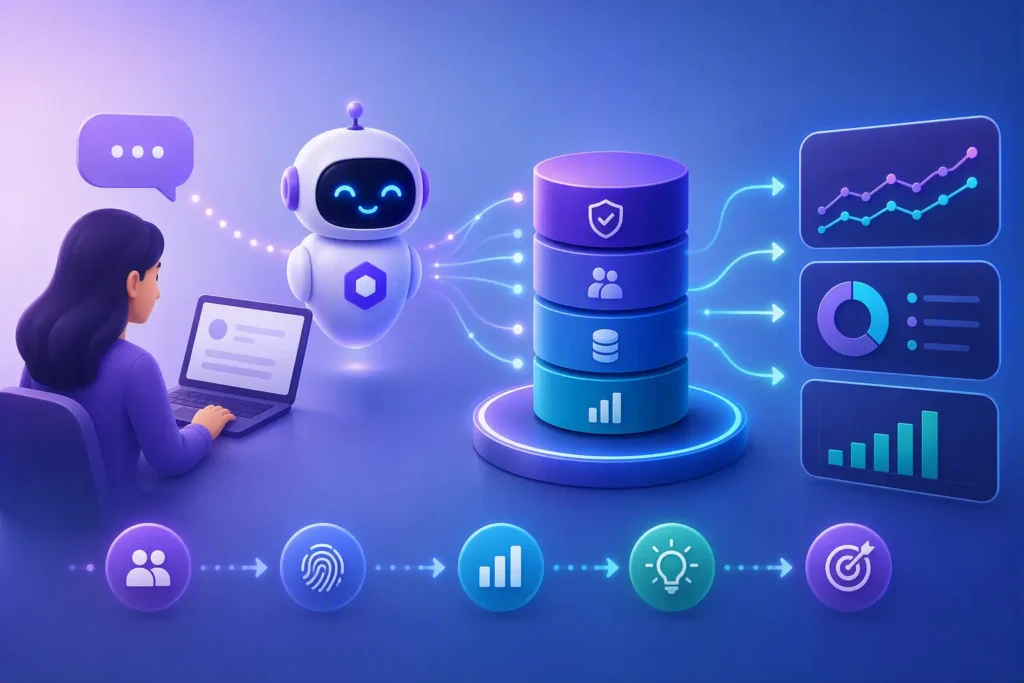
The result was the AI Agency platform, which Capan described as a “very unique” ecosystem: an end-to-end solution in which strategy, research, omnichannel and creative agents all “talk to” each other—but with human experts still very much in the loop to oversee the agents’ work.
Media in the middle
In the realm of media specifically, AI has been in widespread use for quite some time. As Leitner pointed out, it’s embedded in popular publishing tools like Meta’s Advantage+ and Google’s Performance Max and Demand Gen, and automation is inherent to the practice of programmatic media buying.
Now, the media leader said, his team’s AI efforts are focused “more upstream,” using the technology to delve into rows upon rows of marketing intelligence data and draw out information to inform a media strategy. AI tools collapse the amount of time needed to dig through those datasets for meaningful insights from days to just a few hours, Leitner said, reminiscing on the days when competitive reporting came on crash-prone physical discs and queries about print ads required a trip to the agency library.
“We’re well past that. It’s literally all at our fingertips, taking all of this knowledge and then pulling it all together quicker and faster,” he said. “But keeping the integrity and accuracy of what is in that data is really where we’re focusing.”
Further downstream, Leitner’s team is testing out AI-powered tools like DeepIntent’s Helix to aid in building audiences, accelerating measurement and addressing its clients’ other needs—using the tools “to answer the questions that are keeping them up all night and not leave them waiting for weeks or months to get a verified answer,” he said.
On the agentic front, Leitner said his group has already built 10 to 20 AI agents to handle tasks like QA trafficking, paid search ad plan development and more, with another 10 to 15 agents “on the roadmap to be built this year.”
With that army of agents in place, the media team will be able to better connect with other groups across the agency and then automate that collaboration. Leitner described an example situation in which agents are able to work cross-functionally to regularly update HCP lists and deploy dynamic creative assets to target specific HCPs based on past engagement and outcomes data.
“It’s going to pull in from creative on the front end, and then on the back end, all of that media data is going to get funneled into our analytics and outcomes reporting … and allow us to really flesh that out in a way that clients will not have to wait for lagging KPI measures,” he said. “It will be at our fingertips a lot sooner.”
He continued, “So media’s kind of in the middle: plugging in creative—that does a lot of that brand positioning and bringing those thoughts and positions to life—into media and then measuring both media and creative, and then playing that back full circle a lot faster than it’s ever been.”
Keeping humans in the loop
Both Leitner and Capan stressed that an agentic world still has plenty of room for humans.
No matter how accurate and autonomous the aforementioned fleet of AI agents can be, human experts will remain a key piece of each decision point of the pharma media and marketing loop, Capan said. Humans are still needed to ensure that media briefs, creative briefs and overall strategies make sense not only for a human audience, but also based on the research and resources at hand.
In the case of the latter, for example, media agents are wont to come up with plans that max out the entire available budget, “so humans still need to make decisions to say, yes, this budget planning is good,” he said.
As Leitner explained, “humans are still able to provide an element of deep insight that, right now, AI cannot necessarily provide”—though he noted that the technology will surely mature in that department over time.
There’s also the fact that AI tools are still prone to hallucinating and offering completely incorrect answers, so their outputs can’t yet be trusted at face value, Leitner said. With all these limitations in mind, he suggested instead that the acronym be flipped around to “IA,” to stand for the “intelligent assist” that they can offer to humans.
So, in response to the common refrain that AI will steal human jobs and reduce the amount of work available to humans, Capan dissented.
“Honestly, AI makes us more busy, actually,” he said, suggesting that for many people across industries, “Now that you have all these tools, your boss is expecting you to do more.”
Per Capan, workers at an agency fully immersed in agentic AI will be able to leave behind “mundane tasks” in favor of higher-level, more intellectually rigorous work, including supervising AI agents and their outputs.
Staying competitive in the age of AI
As agentic AI becomes more widespread and easily accessible, another question arises: What’s stopping health and pharma companies from developing agentic media and marketing tools themselves so they can bring the work in house?
In answer, Capan pointed to the broader, decades-old push and pull between in-housing and outsourcing to agencies, where pharmas have often made bold proclamations about taking marketing work internal before eventually handing it back to an agency partner. He noted that while many clients may indeed be in the process of building their own AI tools, history shows that “it’s not going to be easy for them,” especially with all the technical expertise required to build agentic AI.
That said, he welcomed the “healthy competition,” suggesting that dabbling in AI development can make clients more knowledgeable when it comes to choosing the right agency partner.
Overall, he concluded, in the current AI arms race, it’s crucial for agencies to be “in the game” and actively planning for how agentic AI may impact the current landscape, whether or not that includes increased in-housing.
Leitner, too, is “not worried” about the onslaught of AI eliminating the need for agencies, especially since building and deploying agentic AI takes lots of capital and lots of expertise.
In fact, he noted that the AI boom may actually open up new avenues for agency partnerships: For one, he suggested, “We could go down a route where we end up building these incredible agents—everything works from end to end, where they can be done on a modular basis—and it becomes a SaaS model.”
For another, Leitner shared that the agency is already serving in a consultant role to clients looking to get into AI development themselves.
“They admit they don’t know what’s going on, and we are two, maybe three years ahead,” he said, describing how that “first-to-market advantage” has allowed the agency to help clients get started on their AI journeys before they venture out on their own.
“But it’s going to be an area that requires constant learning,” he continued. “And having that kind of consulting expertise, I think, goes a long way for clients in building a partnership and then, in the longer term, working side by side in whatever those needs are as partners.”
For more on The State of the Agency, click here.
Related solli Training Course:
Interested in learning more about AI’s impact on pharma media? Dive even deeper with this training course on how AI is transforming the search landscape.