


























The Future of Measurement in the Era of Fragmentation
Turning fragmented data into connected insights and confident decisions.
This piece was written by Justin Rosen, Head of Measurement Product, IQVIA Digital
Healthcare marketers have never had more opportunities to reach out and connect with patients and healthcare professionals.
Campaigns now span everything from connected TV to point-of-care, endemic and lifestyle media to a growing array of direct-to-patient engagement programs designed to meet increasingly empowered healthcare consumers where they seek information, support and care. As patients take a more active role in healthcare decision-making, marketers are investing across a broader mix of channels and touchpoints to deliver personalized, relevant experiences throughout the patient journey. As these investments continue to grow, organizations are facing increased pressure to connect marketing activity to commercial outcomes and demonstrate return on investment.
The challenge is that patients have evolved faster than the industry’s ability to market to them or measure their journeys, creating a growing disconnect between how healthcare decisions are actually made and how engagement is planned, executed and evaluated.
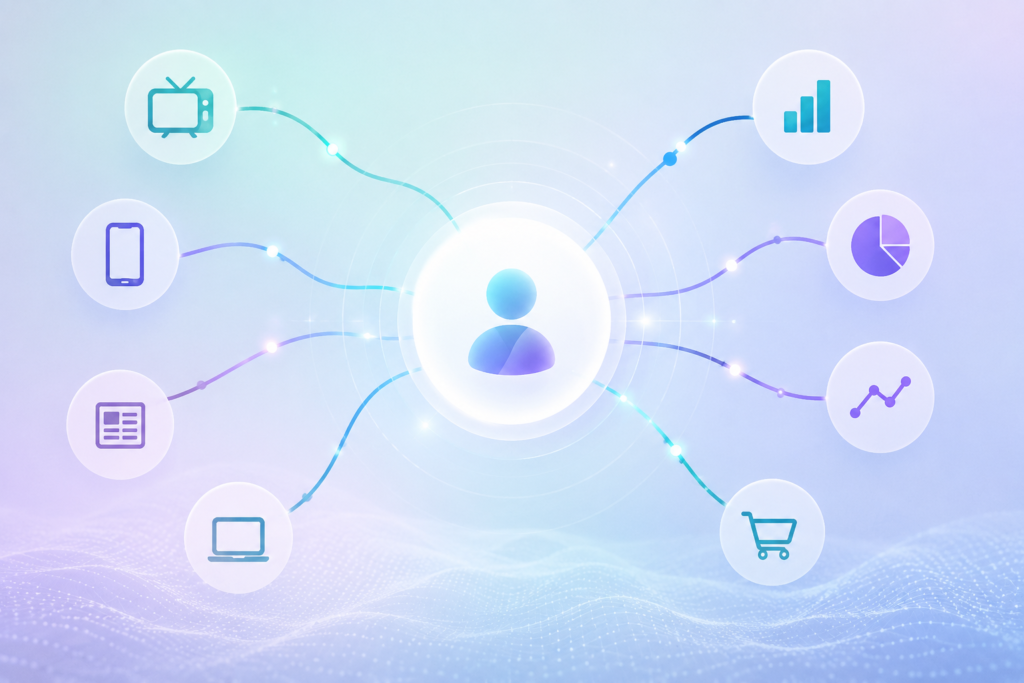
Channel-specific reporting can provide valuable insights into individual campaign performance, but marketers are often left trying to reconcile results across multiple platforms, datasets and methodologies. Questions around overlap, incremental impact, audience exposure and outcomes become increasingly difficult to answer when measurement remains fragmented across disconnected environments.
As a result, organizations may have more data than ever before, yet less confidence in their ability to understand the complete picture.
Fragmentation is not temporary
The assumption has long been that fragmentation is a problem for the industry to fix. The reality is that fragmentation is becoming the operating system of the market, and the organizations that will win the next era of healthcare marketing will not be those that wait for the ecosystem to become less fragmented. They will be the ones that learn how to operate effectively within that fragmentation, turning complexity into a source of competitive advantage.
The healthcare ecosystem continues to expand across new channels, activation platforms, identity solutions, data partnerships, privacy frameworks and analytics environments. Every year introduces new opportunities to engage audiences, but also new complexity in understanding performance.
This shift requires a change in mindset. The goal should not be to eliminate fragmentation; this notion has become increasingly unrealistic as the ecosystem evolves. Instead, organizations must learn how to operate effectively within cross-channel complexity.
As the industry evolves, success will depend on the ability to create connection across environments, compare performance across diverse channels and generate strong insights despite growing complexity.
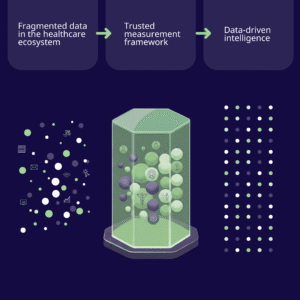
The future of measurement is not about making the ecosystem less fragmented. It is about creating clarity within it as consumers and healthcare professionals engage across a growing number of channels, from offline and online media to point-of-care environments and specialized patient communities. As those engagement opportunities expand, so too does the complexity of understanding performance across them. Industrywide shifts toward cross-platform measurement, full-funnel accountability and outcome-based optimization suggest that the demand for more connected and comprehensive measurement will continue to grow.
Identity: the foundation of better measurement
Since effective measurement depends on connecting often disparate datasets, identity has become the foundation that makes a connected view of performance possible. As brands increasingly rely on data from a growing network of partners, platforms and providers, inconsistencies in how audiences are identified can create significant challenges. Many identity approaches were designed for specific use cases or environments and do not always integrate seamlessly across the broader ecosystem. As organizations seek to connect an expanding number of channels, touchpoints and datasets, consistency, transparency and continuity of identity become increasingly critical.
Connectivity alone is not enough.
When identity is inconsistent, marketers are often left wondering whether they are seeing the full picture of campaign performance or just fragments of it. What is positioned as comprehensive results may, in reality, reflect the limitations of how audiences were connected across datasets rather than the true impact of marketing efforts. That uncertainty can slow decision-making and makes it harder to apply learnings from one campaign to the next.
The real objective is not “connectivity for connectivity’s sake.” Rather, it is to create a trusted measurement framework capable of transforming an ever-expanding universe of data into meaningful insights and confident decisions that drive better outcomes. That requires more than identity. It requires confidence in data sourcing, data quality, methodology and transparency.
Together, these elements create the foundation necessary for organizations to measure performance consistently, compare investments effectively and generate insights they can confidently act upon.
In this context, identity is not the destination. It is one of the foundational capabilities that makes modern measurement possible.
From connected data to connected decisions
While much of the industry conversation focuses on connecting data, marketers are ultimately tasked with making decisions. They need to understand what worked, what influenced outcomes, which investments generated incremental value, which channels complemented one another and where future budgets should be allocated. These are business questions, not resolution questions, and connecting datasets alone does not answer them. Not all signals carry the same value, and not all measurement approaches produce the same level of confidence.
As organizations increasingly rely on measurement to support planning, investment decisions and optimization strategies, confidence becomes a critical differentiator. Connected data creates potential, where reliable measurement creates action.
As an example, marketers are increasingly seeking cross-channel measurement approaches that quantify incremental reach and performance across broadcast television, streaming video and digital environments rather than evaluating each platform independently.
This is where measurement becomes more than reporting. It becomes a source of business intelligence. By understanding how channels work together rather than in isolation, marketers can move beyond disconnected metrics and develop a more complete view of performance, turning fragmented data into actionable insight and more confident business decisions.
‘Measurement Everywhere’
If fragmentation is becoming the permanent reality of consumer behavior, healthcare marketing and measurement must evolve accordingly. Historically, measurement has often been treated as a post-campaign exercise, where marketing activity occurs first, followed by analysis and reporting after campaigns conclude. That model made sense when engagement channels were fewer, campaign cycles were longer and measurement was primarily designed to validate performance after the fact.
Today’s environment looks very different. Marketing decisions are increasingly continuous, campaigns are optimized in flight and new channels/tactics emerge regularly. Audience engagement occurs across a growing number of digital and non-digital touchpoints, which has caused the pace of decision-making to accelerate, while at the same time the complexity of understanding performance has increased.
This reality has shaped how we think about measurement at IQVIA Digital. Our experience measuring hundreds of client campaigns each year and informing outcomes has reinforced a simple belief: Measurement creates the greatest value when it is integrated into decision-making, not reserved for campaign retrospectives.
We believe measurement should serve as an ongoing decision support capability that helps organizations plan, optimize, validate and improve performance throughout the marketing lifecycle. In other words, measurement should not exist only at the end of a campaign. It is the intelligence that should exist wherever marketing decisions are being made.
We often refer to this philosophy as “Measurement Everywhere.” It is not the idea that everything should be measured in the same way, nor is it the belief that all marketing activity should operate within a siloed access point. Instead, it reflects the belief that measurement should be embedded within the workflows where organizations make business decisions about their marketing.
In this approach, measurement becomes more than validation—it becomes enablement. The objective is not simply to determine whether a campaign worked, it is to continuously understand and build on what happens next. As the healthcare ecosystem becomes increasingly split, organizations will need more than additional reports and dashboards. They will need connected intelligence across partners, channels, tactics and ad formats, transforming detached campaign activity into actionable outcome-based insights.
The organizations that gain the greatest advantage will be those that embed measurement throughout the entire marketing lifecycle, transforming it from a record of what happened into an intelligence capability that shapes what happens next.
Making ‘Measurement Everywhere’ practical
If “Measurement Everywhere” is the philosophy, what is required in practice?
Every channel introduces different measurement challenges. A completeness gap in one environment, a walled garden in another or inconsistent methodologies across partners can all distort results. The strongest measurement strategies identify those issues early and rely on transparent methods that can be explained, validated and trusted.
The goal is not perfect visibility into every signal. The goal is to create ample continuity, confidence and visibility across data sources to support holistic measurement and better decisions.
Added to this, healthcare and pharma require an even more disciplined approach. Smaller sample sizes across many specialty areas, combined with growing privacy constraints, raise the standard for how data is connected, measured and interpreted. When confidence in the underlying data is limited, confidence in the resulting insights quickly follows. That makes scale, match rates and accuracy even more important, while strengthening the case for a neutral partner that can sit between advertisers, agencies, partners and publishers without being pulled in one direction.
For evaluating a measurement or data partner, the key questions come down to:
- Is the input data deterministic, first-party, sourced at scale and persistent over time?
- Is the methodology transparent enough for a non-specialist to understand how the results are produced?
- Do the combined inputs contain enough real-world overlap to produce meaningful results?
The answers to those questions should make the path forward clearer, so marketers are in a much better position to act on the output.
Un-fragmenting the fragmented
The future of measurement is not dependent on any single platform, channel or identifier. As the healthcare ecosystem continues to expand, organizations will need measurement approaches capable of creating consistency and understanding across an increasingly diverse set of environments. Connection disparity will continue to increase as new channels, data environments and privacy requirements reshape how organizations activate and monitor marketing performance.
The goal is not to eliminate that complexity. The goal is to create clarity within it.
As healthcare marketers navigate an expanding landscape of media, data and engagement opportunities, success will come from the ability to consistently understand performance across diverse marketing channels and datasets. Organizations need flexibility in how they activate, engage and analyze data. They also need confidence that disconnected signals can be connected into an intelligence layer of what worked and which supports decision-making.
This is where the future of measurement extends beyond connectivity alone. Connectivity provides continuity. Data provides context. Measurement provides understanding.
The organizations that create the greatest advantage will be those that combine these capabilities to generate meaningful insights and confident decisions across an increasingly complex ecosystem, built within their strategy. At IQVIA Digital, this is the idea behind “Measurement Everywhere”: a trusted measurement layer capable of connecting marketing activity to business outcomes wherever clients work and decisions are made.
Ultimately, the future of measurement is not about eliminating fragmentation—it is about un-fragmenting the fragmented; creating a privacy-conscious understanding of impact that enables marketers to move beyond disconnected metrics and toward smarter, more confident decisions.