






















The Case for In-Person Connections in Pharma Media
In-person connections in an AI-shaped world, from HCP engagement to patient trust, loneliness and digital fatigue.

Pharma media brands have become extraordinarily good at reaching people without meeting them. AI can now accelerate audience modelling, segmentation, creative testing, medical copy adaptation, programmatic optimisation, email journeys, social listening, CTV planning, congress follow-up and CRM orchestration. The virtual ecosystem is not failing. In many ways, it is becoming more effective than ever.
ON24’s 2025 life sciences benchmarks, for example, reported a 34% increase in total engagement, a 50% rise in CTA conversions, a 65% increase in registration-to-attendance conversion and an average 52 minutes of engagement for life sciences webinars. Digital channels are clearly creating value for HCPs, patients and brands.
But that is exactly why in-person connection now matters more.
When everything can be automated, optimised and personalised, the scarce commodity becomes physical presence. A strategic opportunity for pharma media in 2027 and beyond is not to retreat from AI or digital channels. It is to use them to make real-world engagement more intentional, more useful and more human.
AI is raising the ceiling, but it is also flattening the room
Inspired by a recent keynote I attended by Caroline Gorski’s “Learning to Speak Machine” makes a useful point for pharma: AI is brilliant at reducing friction, but it can also standardise expression, behaviours and expectations. That concern is supported by current evidence. In a 2025 Quarterly Journal of Economics paper, access to a generative AI assistant increased customer-service productivity by 15%, with the largest gains among less experienced workers. The same study also found evidence that AI drove convergence in communication patterns, with lower-skilled agents beginning to communicate more like higher-skilled agents.
For pharma media, that creates a subtle risk. The more brands use similar AI systems, trained on similar data, optimising against similar metrics, the more campaigns may begin to sound and feel alike. More efficient, yes. More fluent, yes. But also more interchangeable.
That is not an argument against AI. It is an argument for balance. AI should make media smarter; it should not make brand experience thinner.
AI’s health adoption curve shows why this matters now. On the patient side, AI is already part of the health journey: KFF reported in 2026 that roughly one-third of U.S. adults had used AI tools or chatbots for physical or mental health information in the past year, and 41% of those users had uploaded personal medical information such as test results, symptoms or doctors’ notes into an AI tool. That means the virtual health-information layer is no longer marginal; it is intimate, behavioural and already shaping how people interpret their health before, between and sometimes instead of professional care. On the HCP side, adoption is accelerating just as quickly: the AMA reported in 2026 that more than 80% of physicians were using AI professionally, while Doximity found that physician use in practice rose from 47% in April 2025 to 63% in January 2026. Together, these figures point to a new reality for pharma media: AI is now present on both sides of the healthcare relationship, influencing how patients seek answers and how clinicians work, which makes trusted human connection more important, not less.
By 2027, AI will be table stakes for all. The differentiator will be what brands choose to do with the time, intelligence and efficiency it creates.
The cultural signal: people want to be less mediated
The broader consumer mood is moving toward a recalibration of digital life. A 2025 Harris Poll and Quad study of more than 2,000 respondents found “widespread consumer desire for more in-real-life brand experiences,” with the report framed around a shift back toward physical and tangible connections. EY’s 2025 UK research found that 38% of consumers were concerned about too much screen time and wanted a digital detox; among 18–34-year-olds, 47% said online activity felt more disruptive than beneficial to wellbeing.
People still want useful digital experiences, but they increasingly recognise the difference between being reached and being connected.
Healthcare should take this seriously because connection is not just a media preference; it is a health factor, and one that will become more urgent as populations age. In 2025, the WHO Commission on Social Connection reported that one in six people globally is affected by loneliness, linked to an estimated 100 deaths every hour and more than 871,000 deaths annually.
Scientific evidence is reinforcing the point: 2025 studies in Nature Human Behaviour and Nature Mental Health linked social isolation and loneliness to biological signatures involving inflammation and immune response, as well as higher risks of mortality, cancer-related mortality and functional impairment. A 2026 BMC Medicine analysis of nearly 490,000 UK Biobank participants similarly associated social isolation with increased all-cause and cause-specific mortality risk.
In the U.S., this challenge is growing: Census Bureau data released in 2025 showed that the population aged 65 and older rose 3.1% in a single year to 61.2 million, while the Congressional Budget Office projects the ratio of working-age adults to people aged 65+ will fall from 2.8:1 in 2025 to 2.2:1 by 2055. For pharma brands, this should not be overlooked. As more patients age into higher-touch, multi-condition care journeys, and as HCPs face greater pressure from a larger older population, in-person connection becomes more than a communications tactic. It becomes part of how brands can support trust, understanding, adherence and human care.
For pharma, this is highly relevant. If the industry exists to improve health outcomes, then the environments in which information, support and trust are exchanged matter. Media is not just message distribution. It is part of the health experience.
HCP engagement: in-person still carries disproportionate value
The case is not that every HCP wants more rep visits or that every patient needs another event. The case is that in-person engagement has a different job to do.
IQVIA’s 2025 Channel Preference Survey found a gap between HCPs’ preferred and actual engagement channels across top European markets, with face-to-face interactions, email and post among the key drivers of alignment and misalignment. It also reported that alignment varied sharply by specialty: dermatologists, GPs and ophthalmologists were above 60%, while oncologists, haematologists and nurses were below 50%. That is a planning point: the answer is not “more in-person everywhere.” It is better mapping of where in-person interaction solves a real audience need.
Congresses still matter, but they should not be the only physical format in the plan. IQVIA’s 2025 congress research reported that three-quarters of HCPs considered in-person congress attendance a critical or very important channel for scientific content and networking. That reinforces the value of live scientific exchange, but it also raises a bigger question: why should meaningful in-person engagement be concentrated around a handful of major meetings?
The next opportunity is to design smaller, more specific, more useful real-world activations around moments of need: local peer-learning forums, nurse-led patient education sessions, diagnostic awareness clinics, community screening partnerships, hands-on device training, multidisciplinary pathway workshops, condition-specific listening rooms, caregiver support gatherings, and live creator or advocate meetups where trusted voices can meet audiences directly.
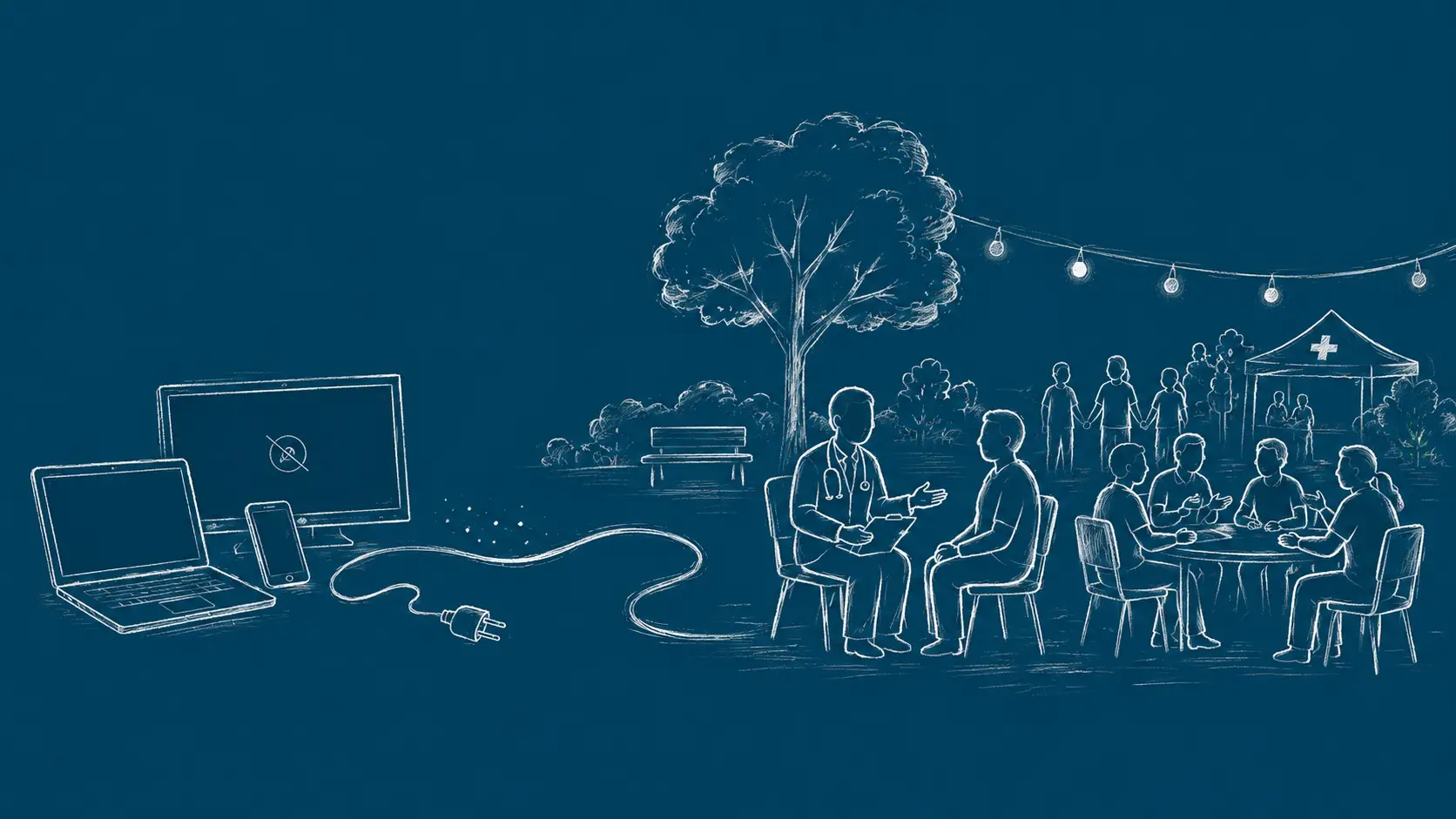
Real-world activation can do what media alone cannot
AstraZeneca’s NHL partnership is a useful example. Its “Get Body Checked Against Cancer” campaign with the NHL and NHLPA uses the cultural context of hockey to encourage fans to talk to doctors about cancer risk factors and appropriate screenings. In 2025, AstraZeneca extended the effort with sportscaster and cervical cancer survivor Erin Andrews to help encourage people to stay up to date with recommended cancer screening.
That is not just awareness. It is a value exchange: the brand enters a real-world community, borrows the emotional permission of a shared passion point, and gives people a concrete health action to consider.
More pharma media plans should think this way. Not “how do we sponsor an event?” but “where does our audience already gather, what health value can we add, and what human exchange would make the message more credible?”
For HCPs, that might mean expert-to-peer environments where the value is clinical confidence, not promotional exposure. For patients, it might mean trusted community moments where the value lies in education, reassurance, navigation, or screening. For caregivers, it might mean practical support in places where they already spend time. For underserved groups, it might mean activations designed with community partners rather than broadcast to them.
The 2027 planning implication
Of course, long gone are the days of digital-first or physical-first plans; the strongest pharma media plans should be connection-first, platform agnostic and threaded throughout touchpoints.
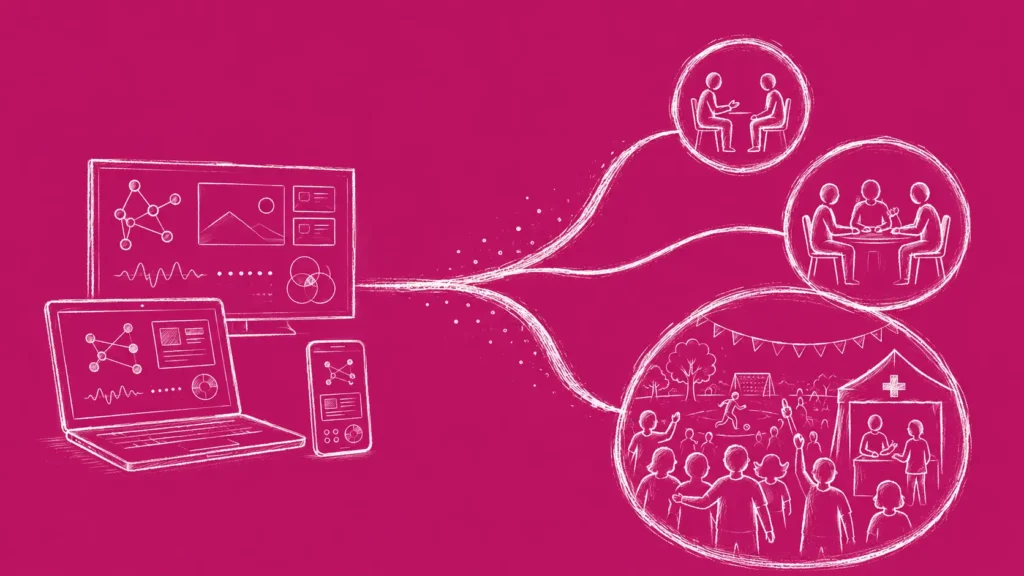
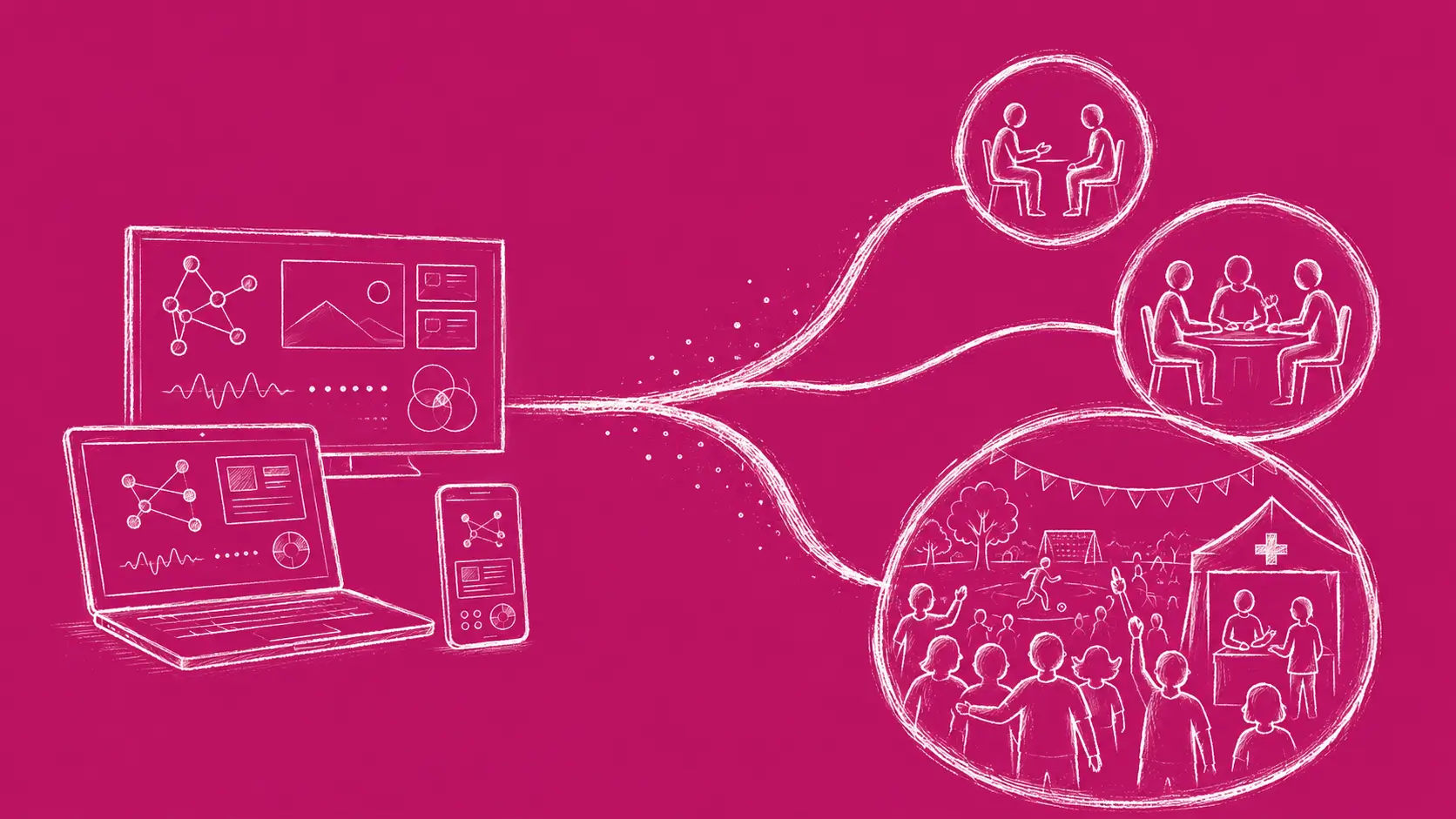
That means using AI and digital channels to identify need, reduce waste and prepare the ground, then using in-person moments to do the work that screens cannot do as well: build trust, create peer validation, listen deeply, support behaviour change and make health feel less abstract.
A practical planning model might look like this:
- Before the moment: AI identifies audience segments, local unmet needs, content gaps and likely barriers. Programmatic, CTV, email and social create awareness and invite participation.
- During the moment: HCPs, patients, advocates or community partners come together around a clear value exchange: education, screening, training, peer dialogue, adherence support or shared decision-making.
- After the moment: Digital journeys sustain the relationship, personalise follow-up, connect people to resources and measure behavioural or attitudinal change.
The point is not to add live activity as a decorative layer on top of an omnichannel plan. The point is to make in-person connection a deliberate media asset.
What in-person connection could look like
This should fall to the media team, not sit separately with congress, creative or comms. These are media activations: planned against audience need, powered by data, connected into the wider channel ecosystem, and measured as part of the journey rather than as isolated events.
The opportunity is to move beyond “live” meaning congress booths, rep meetings or sponsored symposia, and instead build physical connection into the media plan itself.
- Community health activations
Brands can show up in trusted cultural spaces – sport, music, faith, workplaces, retail or local community events — with a clear health value exchange such as screening prompts, symptom education, vaccination awareness or navigation to care. The role of media is to identify the right audience, drive attendance and sustain follow-up. - Local peer-to-peer HCP forums
Smaller regional forums can help clinicians discuss pathway barriers, diagnostic delays, patient-management challenges or real-world evidence with peers. These should feel less like broadcast education and more like practical clinical problem-solving. - Patient and caregiver pop-ups
Pop-ups in pharmacies, community centres, libraries, employer campuses or advocacy events could offer nurse-led Q&A, appointment-preparation support, device training, adherence guidance or caregiver resources. The brand earns attention by making the care journey easier. - Advocate- and influencer-led live experiences
Health creators, patient advocates and trusted community voices already shape understanding online. Bringing them offline through live conversations, small-group workshops or moderated Q&As can turn digital trust into deeper, more human connection. - Custom value-exchange events
Brands can create new formats around unmet needs: diagnostic roadshows, screening partnerships, caregiver bootcamps, multidisciplinary care days or community navigation clinics. These should be built with advocacy groups, local health systems, pharmacists, nurses or community organisations so the experience is grounded in real need.
The idea is to make in-person connection a deliberate media asset. Digital channels can still do the targeting, invitation, education, retargeting and measurement, but the physical experience creates the memory, credibility and trust that are harder to build on a screen.
The opportunity hiding in plain sight
Pharma has spent years building increasingly sophisticated virtual engagement engines. That investment should continue. AI will make those engines faster, more predictive and more personalised.
But the data points to a clear counter-trend: HCPs still place high value on face-to-face interaction and congress networking; patients are ageing into more complex, higher-touch care journeys; loneliness is becoming a recognised health risk; younger audiences are actively looking for ways to disconnect; and digital content is becoming so abundant that attention, trust and memorability are harder to earn.
That is the opportunity hiding in plain sight. The brands that stand out will be the ones that remember what technology is supposed to protect: time, attention, trust and human connection.
In an AI-shaped media environment, a well-designed in-person activation may become one of the most differentiated things a pharma brand can do. Not because it is old-fashioned, but because it is harder to copy. It carries context. It creates memory. It allows people to ask the question they would not type into a chatbot. It lets a patient hear from someone who has been there. It lets an HCP test a message against peer experience. It cuts through digital overload by turning information into confidence.
The case for in-person connection in pharma media is not sentimental. It is strategic. AI can make pharma media work better across every channel, but real-world connection can make it matter more in a world flooded with digital information.