































Anticipating HCP Prescribing Behavior Pre-Diagnosis
PulsePoint’s Approach to Rare Disease Omnichannel Marketing Efficiency


IN RARE DISEASE MARKETING, EVERY PATIENT MATTERS, BUT TIMING MATTERS EVEN MORE
Traditional pharmaceutical marketing often relies on claims-based triggers that activate 30 days after diagnosis, leaving little opportunity for meaningful brand engagement. By this time, treatment decisions are often already made.

To address this challenge, a pharmaceutical brand partnered with PulsePoint with a clear objective: identify high-probability prescribers before patient diagnosis, when treatment consideration is actively forming.
HCPs may encounter only one or two patients with a rare condition in their entire careers, and each patient typically consults two to three specialists before receiving a diagnosis. As a result, meaningful clinical moments are limited, highly distributed, and difficult to predict.
In this particular case, that reality translated to approximately 15,000 relevant clinical encounters per year spread across nearly 55,000 specialists nationwide. When a diagnosis is finally made after a prolonged diagnostic journey, treatment decisions tend to occur rapidly, leaving little room for post-diagnosis engagement to influence choice.

PulsePoint developed a predictive targeting framework to help the brand combine its real-time digital engagement signals, brand engagement insights, and clinical insights with omnichannel automation to identify and engage high-probability prescribers before diagnosis occurred.
The approach balanced two critical objectives: maximizing coverage of actual prescribers while minimizing wasted reach to non-relevant HCPs.
The solution centered on creating two distinct HCP segments aligned to different stages of the clinical journey, each with customized targeting rules, data signals, and messaging strategies:
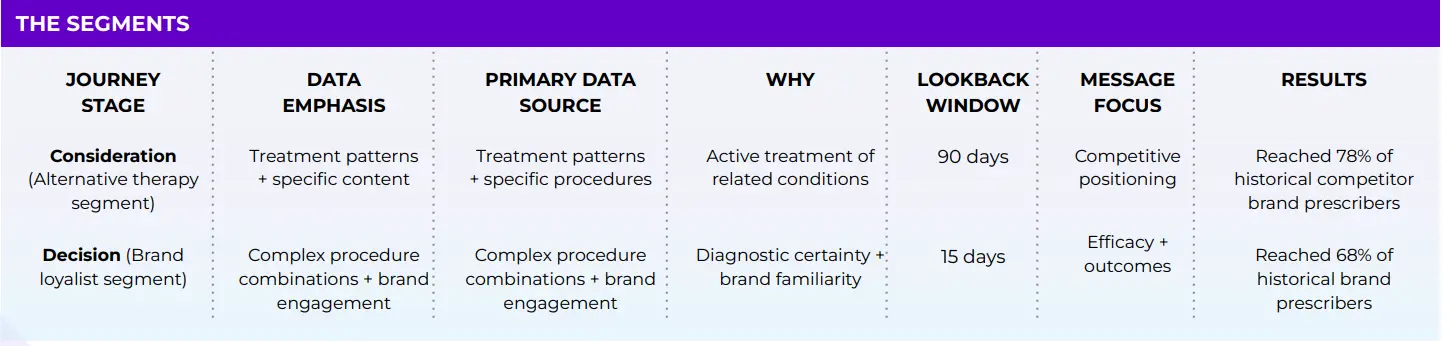

Rare disease marketing success depends on continuous HCP identification and refresh to ensure engagement occurs during narrow, high-impact clinical windows.
Success in this case required the seamless integration of three core platforms within PulsePoint’s HCP omnichannel ecosystem, each serving a distinct but interdependent role to enable automated next-best-engagement opportunities.
The breakthrough came from how these platforms worked together rather than in isolation.
● HCP Explorer identified the “who” and “when.”
● Life executed the “how” and “where.”
● HCP365 refined the “what” while validating the “why.”
1. Multi-Signal, Real-Time Intelligence Engine: HCP Explorer
HCP Explorer served as the predictive analytics foundation, transforming fragmented healthcare data into actionable, high-value HCP targeting segments.
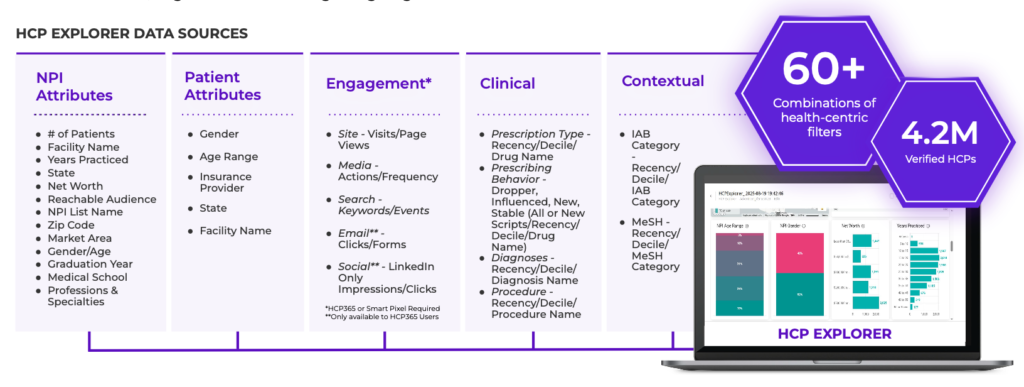
HCP Explorer’s 60+ filter combinations and purpose-built healthcare contextualization engine allowed precise calibration of targeting rules to match clinical journey stages.
HCP Explorer analysis revealed that content engagement functioned as a leading indicator of clinical activity, while procedural combination diagnostic patterns proved to be reliable predictors of intent.
This data intelligence fed directly into PulsePoint’s Life DSP for omnichannel activation, creating dynamically refreshed segments that continuously identified newly qualifying HCPs without manual intervention.
2. Precision Health Programmatic Delivery: Life DSP

PulsePoint’s DSP continuously targeted new HCPs entering high-probability clinical windows.
The platform’s omnichannel orchestration enabled coordinated message sequencing across display advertising, email, and content syndication, while frequency management balanced message reinforcement with engagement quality.
3. HCP-Level Real-Time Engagement Signals: HCP 365
HCP-level analysis proved to be essential to understanding the urgency and timing of clinical decision-making. HCP365 closed the loop by capturing real-time brand engagement signals that both informed segment qualification and triggered dynamic creative optimization.
When HCPs visited the brand website and engaged with educational content, these interactions elevated their segment priority scores and unlocked more intensive follow-up messaging.
Conversion event tracking HCP365 triggered automatic next best action within the DSP throughout each HCP’s unique brand journey experience.
Critically, HCP365 data simultaneously fed back into HCP Explorer’s predictive models, creating a continuous learning loop that improved targeting precision with each campaign cycle.


♦ The predictive, multi-signal targeting approach extended the promotional engagement window by 35–60+ days before diagnosis or treatment decisions, delivering a material increase in efficiency and relevance. By shifting from static, quarterly target lists to dynamically refreshed segmentation, the brand narrowed outreach by 87% to prioritize high-probability HCPs only, while maintaining 50-60% segment coverage.
♦ Specific procedure combinations proved to be strong indicators of diagnostic intent while the journey stage dictated which data sources and time windows were most predictive. HCPs with 10 or more endemic content engagements on relevant topics within a 90-day period were 3.2x more likely to be actively managing condition-relevant clinical scenarios.
♦ The results demonstrated that reaching fewer physicians at the right moment drives greater impact than broad, untimed coverage. This enabled a 5-8x concentration of media spend on physicians most likely to encounter relevant patients in the near term. After being identified through PulsePoint’s HCP segments, 32 HCPs subsequently prescribed the drug in 2025, including 12 net new prescribers.

Precision and scale are not mutually exclusive in rare disease marketing when the right data signals are integrated at the right time. The results of this case study validated a fundamental shift in rare disease marketing strategy: invest deeply in fewer high-value HCPs, and deliver better-timed touch points rather than maintaining broad, continuous coverage.
For pharmaceutical marketers tasked with driving results for rare disease therapeutics: Are you ready to drive cost efficiencies and results with PulsePoint’s predictive approach?
Contact PulsePoint today to learn more.