
























Cabana Confidential: Pharma Finds Its Voice at POSSIBLE 2026
Healthcare marketing’s real conversations at POSSIBLE 2026.

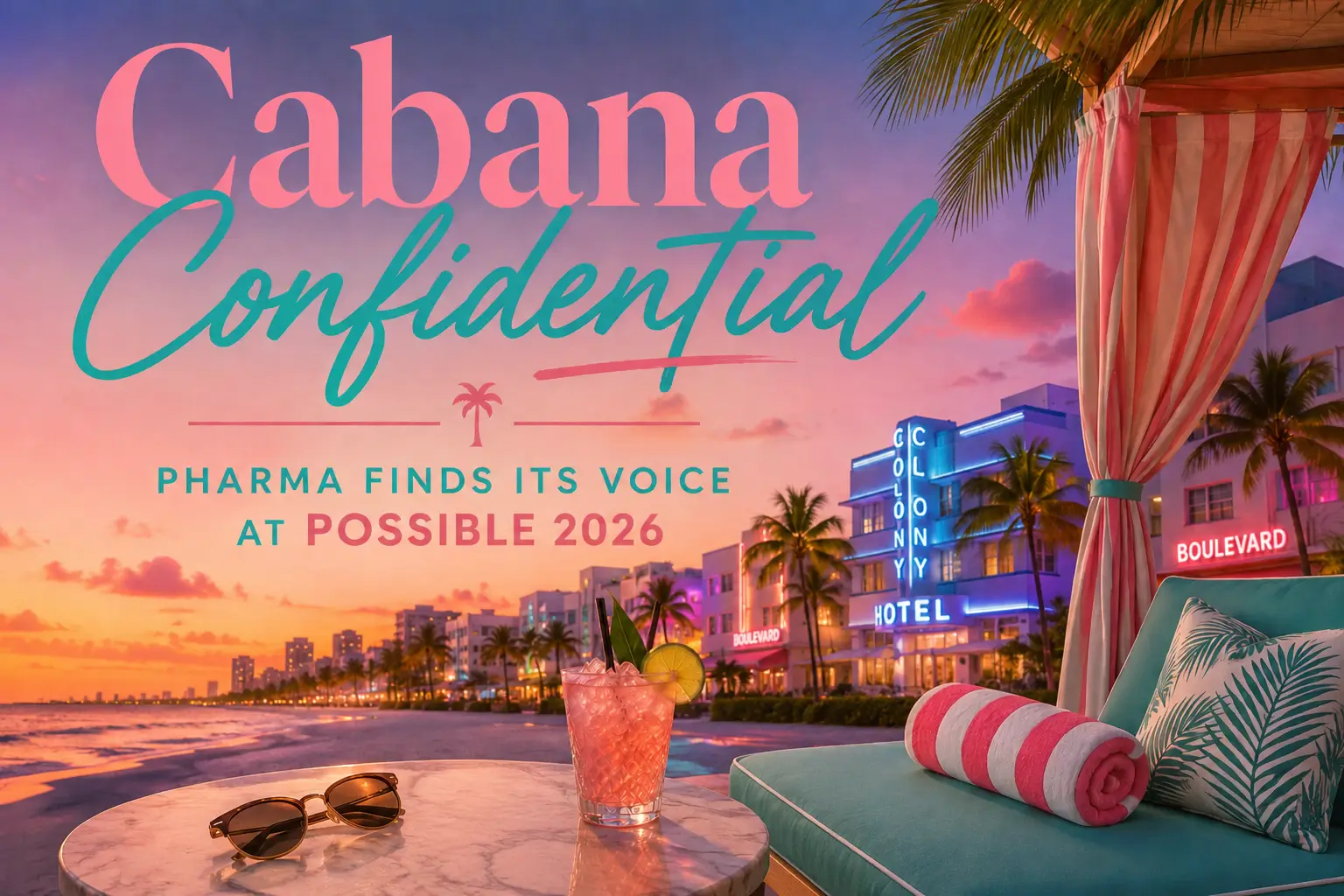
Most of what mattered for healthcare marketers at POSSIBLE 2026 wasn’t on the official program.
Nearly eight thousand people descended on Miami Beach the week of April 27. The Fontainebleau spilled into the Eden Roc and down onto the sand. The official agenda was substantial, with 200 sessions and 394 exhibitors, including an AI Verse stage and a Creator Economy Academy.
But for over a hundred life sciences marketing leaders who made the trip — including large delegations from Pfizer, CVS Health, IQVIA Digital, DeepIntent, and CMI Media Group — the industry-specific content lived somewhere else. The energy concentrated in cabanas, on boat decks, and at lunches that turned into happy hours — on a track the program scarcely acknowledged, but the community had clearly built for itself.
Six conversations dominated the week. Each started on the general agenda and took a healthcare marketing twist in the poolside banter.
1. The Trading Desk Isn’t Dying — It’s Rejiggering
The line everyone repeated by Tuesday afternoon came from David Steinberg of Zeta Global, delivered from the main stage: traditional trading-desk businesses face a twelve-month displacement risk. Autonomous agents now bid without human latency, and the FTE model that defined holding-company economics for thirty years is structurally exposed.
Horizon Media’s Bob Lord pushed back from the same panel, arguing that headcount doesn’t disappear; it repurposes. Buyers become business strategists, and winning agencies will integrate creative, media, and outcome data on one platform to end decades of structural separation.
The healthcare side of the room had a more grounded read. Kristy Quagliariello, VP of Programmatic at Klick Health, has watched these transitions before — from ad networks to DSPs to PMPs.
“AI is no different. The trading desk is finally getting the co-pilot it always needed. When agents handle execution, teams get to work the way they always wanted: collaboratively, proactively, strategically.”
— Kristy Quagliariello, VP, Programmatic, Klick Health
Privately, programmatic leaders across multiple healthcare holdcos echoed this sentiment. The focus is shifting toward a “rejiggering” of talent where the mundane work goes to the agent and the human work gets to be human. The pressure remains real: agencies without a clear answer for how their trading function survives agentic execution won’t be in the conversation by 2027.
2. Patients Are Armed to the Teeth (and Pharma Isn’t Watching)
The most pressing operational problem of the week wasn’t on a panel. Senior marketers from financial services, retail, and consumer health surfaced it independently: brands are showing up incorrectly in AI-generated search results, and the industry lacks a clean fix.
In pharma, this “visibility gap” is accelerating. Roshen Mathew, Chief AI and Innovation Officer at SSCG Media Group, highlighted a startling new patient dynamic at an ADWEEK House panel: patients are arriving at appointments with ChatGPT-derived scripts built on false premises, prepared to debate physicians on diagnoses a model probabilistically generated.
“They’re coming armed to the teeth, and it’s frankly scary.”
— Roshen Mathew, Chief AI & Innovation Officer, SSCG Media Group
What appears in AI-generated answers is increasingly accepted as clinical truth. The work for pharma is to audit it now: which models surface your brand, what they say about it, where the misinformation clusters, and which patient queries trigger competitor mentions. Most brands haven’t done step one. The ones that do will set the benchmark for what every brand is asked to report on by mid-2027.
3. Measurement, From Talking Point to Table Stakes
Measurement was the conference’s quiet drumbeat. Across panels on incrementality, causal AI, and the failure of multi-touch attribution to deliver clean answers, the same harder reality kept surfacing: marketing still struggles to prove its impact. Lauren Mee, Director of Platform Partnerships at PurpleLab, named what that shift looks like from the operator’s seat.
“Measurement has stopped being a talking point and started being a requirement. Partners are coming into meetings with specific asks — show me the reports, give me a case study, prove it works in my environment.”
— Lauren Mee, Director, Platform Partnerships, PurpleLab
Clean rooms have moved from theoretical to operational, and audience quality is table stakes. What’s scarce is visibility — the ability to action findings in real-time. In practice, that means dashboards that update intraday rather than monthly and methodology shared with the buyer, not locked in a measurement vendor’s black box.
The foundation underneath it all, according to Colleen Dawe, VP at Experian Marketing Services, is a framework that can “responsibly turn trusted data into more relevant engagement, measurable outcomes, and connected experiences across fragmented environments”. The next phase of measurable success in healthcare advertising will rely on stronger identity resolution and greater interoperability, without compromising rigor in data privacy.
4. Are You Taking Principal Positions on Our Spend?
The transparency conversation opened by Jeff Green of The Trade Desk and Michael Kassan of 3C Ventures on Tuesday vibrated through the cabanas for the rest of the week. The core question — how much agency margin is buried in principal media positions versus disclosed fee structures — lands harder in pharma than in any other category, where transparency expectations run high and procurement scrutinizes fee structure more rigorously.
“For agencies built on principal-based media buying, this is an important conversation. What’s changing isn’t the underlying model of the industry; it’s that more clients are asking the right questions.”
— Kristy Quagliariello, Klick Health
Several agency leaders privately acknowledged what’s left out of the procurement conversation: clients have negotiated themselves into corners on fees, and principal media filled the gap. Disclosure norms vary across the supply chain, and principal media positions sit on real contractual histories that don’t unwind in a quarter.
Agencies that prepare a clean answer now will be in a stronger position than the ones that wait to be asked when 2027 negotiations arrive.
5. Put Patients in the Room, Not the Brief
The week centered on the purpose of AI in healthcare, shifting the focus from technical capability to practical utility. Mark Pappas, EVP of Innovation at CMI Media Group, captured the post-conference mood perfectly.
“AI was everywhere. Every session. Every pitch. But here’s what stood out: people are exhausted by it. Not by the technology. By the hollow brand experiences it is producing. Algorithmically perfect. Emotionally empty.
The real signal at Possible this year was simpler than any tech stack: people are craving real life. Real moments. Real connection with brands that actually show up for them.”
— Mark Pappas, EVP, Innovation, CMI Media Group
Pappas’s pharma prescription was direct: “Put patients in the room, not just in the brief”. Build disease-awareness activations and community moments a DTC spot cannot deliver. Use AI to earn back the time machines can’t replicate emotionally. The brands winning right now, in his read, are using AI to free up space to be more human.
6. The IRL Counterweight
Amidst the noise of tech demos, a counterintuitive consensus emerged in the cabanas: real-life interaction has become more precious because AI cannot replicate it. Reddit co-founder Alexis Ohanian framed it bluntly during the “Building the Next Era of Women’s Sports” session with sprinter Sha’Carri Richardson — the rise of run clubs is the inverse signal of swipe-left exhaustion. Real moments are scarce, and brands that show up in them have an asymmetric advantage.
“Beyond the typical pharma box, sports partnerships have become a dynamic part of our industry — from NASCAR to the NHL and increasingly, women’s sports.”
— Julie Hurvitz Aliaga, EVP, Innovation, Content & Partnerships, CMI Media Group
Aliaga sees this category having moved from peripheral to strategically central. Disease-awareness activations and live community moments connect with patients and HCPs in ways the DTC sixty-second TV spot cannot. The opportunity isn’t novel, but the willingness to take it seriously is.
Looking to 2027
Pharma media leadership is no longer staying in its own lane. The category arrived at a mainstream ad tech conference in real numbers and conducted itself like every other category — hosting dinners, building presence, and having the high-stakes conversations that will define the next two years of RFPs.
The informality of the setting — where cabanas often replaced meeting rooms — lowered the friction on conversations that are usually stiff and guarded. Whether POSSIBLE eventually grows a healthcare-specific track the way Cannes grew Lions Health, or whether the cabanas keep doing the heavy lifting, is the question worth watching.
Jason Lotkowictz is SVP, Life Sciences at PurePlay AI. He has spent fifteen years in healthcare advertising at Kargo, Verywell Health, and InStep Health.