



















Healthcare Marketing’s Next Frontier Requires Better Data Infrastructure
It's time for a smarter foundation
Healthcare marketing is at its inflection point.
For years, the industry has been building toward more personalized, data-driven engagement. Campaigns are getting smarter, reflecting the complexity of patient journeys and the nuance of healthcare professional (HCP) decision-making. The ambition, strategic thinking, and creativity are all there.
What’s changed is the pressure to deliver on it.
Marketers are no longer being asked whether more precise targeting or better measurement is possible. They’re being asked to execute. Quickly, consistently, and at scale. That’s where the gap has become harder to ignore.
Healthcare marketers operate in one of the most data-rich and data-constrained environments at the same time. Clinical insights, prescription trends, provider behavior, and patient journeys all contain signals that could reshape how brands engage their audiences. But connecting those signals in a privacy-safe way remains a persistent challenge for agencies and brands.
In many organizations, the underlying systems weren’t designed for what marketers are now trying to do. As a result, some of the most promising ideas never make it past planning. The infrastructure required to support them either doesn’t exist or takes too long to assemble.
That tension is defining the current moment. Client expectations are rising, and the ideas to meet them are already here. But as our creative ceiling climbs, the infrastructure to execute is struggling to keep up.
Healthcare Data Collaboration Is Reaching a Turning Point
The need for better infrastructure shows up most clearly in how healthcare data is shared and used. Historically, collaboration has been constrained by two realities.
First, healthcare data is highly sensitive. Protected health information (PHI) requires strict safeguards, and organizations must operate within privacy frameworks like HIPAA. That responsibility is paramount.
Second, the ecosystem is fragmented. Pharmaceutical companies, agencies, data providers, publishers, and platforms all operate within separate environments. Valuable insights exist across these systems, but they’re rarely easy to connect.
But new models of privacy-safe collaboration are making it possible to work with healthcare data in different ways. Instead of moving raw data between organizations, partners can analyze and connect datasets within controlled environments designed to protect sensitive information from the start.
This shift is doing more than improving efficiency. It’s changing the kinds of questions marketers can ask. Teams can explore how patient populations evolve over time, looking at comorbidities, prescription behavior, and treatment pathways in more detail. They can connect those dynamics to specific HCPs, uncovering prescribing patterns, referral networks, and channel engagement in a more unified way.
This is the direction the industry is moving, and it’s beginning to take shape in emerging platforms designed for this kind of collaboration. For example, solutions like DeepIntent Helix bring these perspectives together within a privacy-safe environment, enabling marketers to better understand how patient populations and HCP behavior intersect, and how those relationships should inform targeting and messaging.
Instead of working with disconnected views, marketers can start to see how these pieces relate to each other. That changes how strategies are built, making them not just more informed but fundamentally more connected.
Infrastructure Is Becoming a Competitive Advantage
As these capabilities become more available, infrastructure is becoming a visible differentiator.
Organizations with strong data foundations can move from idea to execution quickly. They can test hypotheses, refine audiences, and measure impact without waiting on multiple systems to catch up.
Others face a slower path. Even relatively straightforward initiatives, like defining a high-value HCP audience or evaluating campaign performance across channels, can take weeks or months.
Agencies are feeling it in particular. Clients expect more sophisticated strategies, backed by data and delivered with confidence. Winning new business increasingly depends on showing not just creative thinking but the ability to execute on it.
That includes being able to:
- Segment and prioritize HCPs based on patient populations, prescribing behavior, and channel affinity
- Build custom scoring models that show expected impact before a campaign launches and track performance as it unfolds
- Surface insights quickly enough to shape both pitches and live campaign optimization
These are the kinds of workflows emerging in modern data environments, like Helix, where teams can build and refine HCP profiles using real-world data signals and tie those profiles directly to campaign performance.
At the same time, most organizations aren’t set up to build this level of infrastructure on their own.
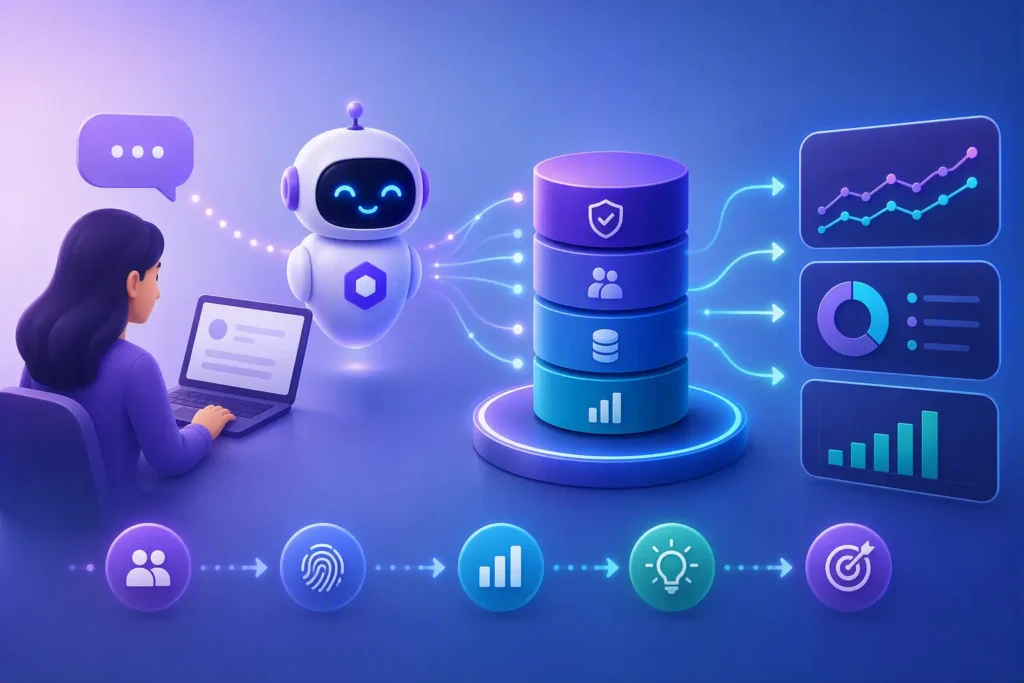
That reality is pushing the industry toward shared environments that provide access to prepared datasets, analytical tools, and activation pathways in one place. These systems reduce the effort required to work with complex healthcare data while still allowing agencies and brands to build their own solutions on top of it.
Making Healthcare Data Usable
Healthcare datasets are often fragmented, inconsistently structured, and difficult to analyze without significant preparation. Even experienced teams spend a large portion of their time cleaning and reconciling data before they can generate insights. That slows everything down.
Newer data environments are changing the starting point. Instead of raw inputs, marketers can work with datasets that are already standardized, connected, and designed for analysis.
This shows up in practical ways, for example, a strategist can explore a patient population and quickly understand key characteristics, such as comorbidities, treatment patterns, and how patients move through care. That same analysis can be tied to HCP behavior, making it easier to define audiences based on what’s actually happening in the real world.
In environments like Helix, teams can query patient populations and immediately connect those insights to HCP-level data, creating a more complete picture of who to reach and why.
From there, audience building becomes more flexible. Teams can create custom HCP and patient audiences that go beyond the limits of traditional planning tools, combining multiple data signals into more nuanced segments. Those audiences can be enriched with first-, second-, and third-party data to improve performance and deepen understanding.
These audiences can then move directly into activation. In Helix, that includes streamlined distribution into programmatic environments as well as onboarding through partners like LiveRamp for social and publisher-direct channels.
This work also feeds into itself.
As new data becomes available, whether from claims, consumer data, or campaign engagement, it can be incorporated back into the system to refine future strategies. That feedback loop is where a lot of progress happens.
From Insight to Activation
Insights only matter if they can be acted on. In many cases, the transition from analysis to execution introduces friction. But when analytics, identity resolution, and activation are connected, the process becomes seamless. Audiences built from rich data inputs can be deployed across channels without unnecessary translation and data loss.
Platforms like Helix are helping to close that gap by linking audience creation directly to activation pathways, reducing the time and effort required to move from insight to execution.
Performance improves as well. Real-time campaign engagement signals can provide a more immediate view into how campaigns are performing at a granular level. Activity from beyond a single platform can be incorporated through media and site integrations, creating a more connected understanding of performance across channels.
This enables more responsive decision-making. Campaigns can be adjusted in real time, and strategies can evolve based on live signals. This ensures every media dollar is working more effectively.
Why the Timing Matters Now
The industry has been moving in this direction for a while. What’s different now is the level of expectation.
- Brands expect measurable outcomes tied to real-world impact.
- Agencies are expected to deliver differentiated strategies quickly.
- Data partners are contributing more sophisticated datasets.
- Privacy requirements remain strict.
Taken together, these forces are raising the bar. What used to be considered advanced is becoming standard. Work that once took months is now expected in weeks, sometimes faster. That’s why infrastructure is getting more attention.
Privacy-safe collaboration environments make it possible to work across organizations without exposing sensitive data. Integrated systems make it easier to connect insights. Activation pathways are becoming more direct. This is all already happening.
Teams that access and apply these capabilities are expanding what they can do, not just improving efficiency.
Supporting the People Who Drive Innovation
Behind all of this are the people doing the work.
- The strategists designing new ways to reach complex audiences.
- The analysts working through messy datasets to find patterns.
- The agency leaders building ideas that win business.
Their challenge is the gap between what they can see and what they can realistically execute within the constraints of their tools and timelines.
But when the underlying infrastructure improves, that challenge starts to shift.
Teams spend less time navigating systems and more time applying judgment. Conversations move from feasibility to strategy. Ideas that once felt risky or impractical become workable, even repeatable.
Our industry has been overflowing with creativity for a long time. Now, it needs the infrastructure in which a health marketing team’s creativity can be realized.