



























The Growth Ceiling of Precision Marketing
How Advanced Practice Professionals Are Redefining Reach, ROI, and Prescriber Influence


Pharma marketing has mastered precision. NPI-based target lists, decile segmentation, geographic alignment, specialty filters — campaigns are engineered to reach the right physician at the right time, with the right frequency. Every impression and every dollar is measured, optimized, and justified. Yet, even with all this rigor, a substantial share of prescribing is quietly happening outside those carefully defined boundaries.
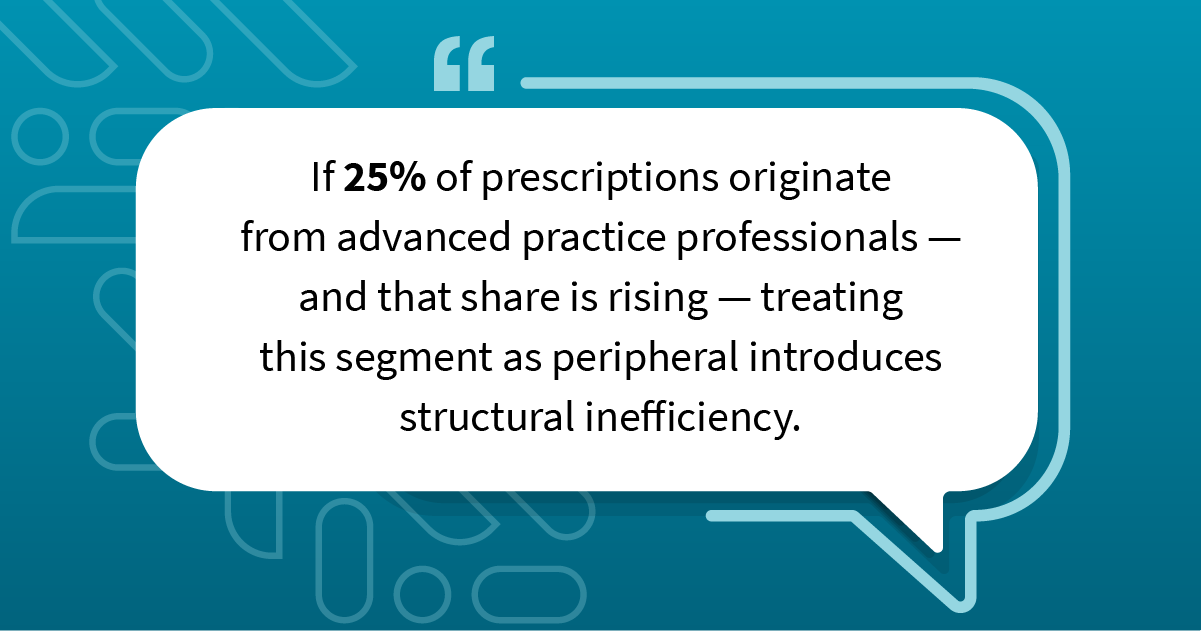
In epocrates’ analysis of prescribing data, nurse practitioners and physician associates now account for roughly one-quarter of prescriptions written annually — clinicians who have historically fallen outside the focus of most campaigns. Think about that: more than 25% of prescriptions are coming from prescribers not on your list (Komodo Health). The implication is clear: efficiency metrics may look strong, but growth is being capped by the very strategies meant to unlock it. What looks like optimization can, in fact, become a growth ceiling.
This is not about missed impressions or sloppy planning. It’s about an ecosystem that is changing faster than our traditional metrics capture. The workforce is shifting, the patient population is more complex, and influence is increasingly distributed across advanced practice professionals who are making independent prescribing decisions, managing chronic care, and counseling patients on treatment adherence. For brands and agencies, ignoring this shift might seem to be the conservative path forward, but the reality is more detrimental for brands: it leaves growth on the table.
The Target List Has Become a Strategic Boundary
The NPI-based target list has been a cornerstone of pharma media strategy for decades. Significant resources are invested in validating internal datasets against external sources, segmenting prescribers, and aligning spend to projected ROI. Success is measured by how efficiently campaigns reach this defined audience and how thoroughly impressions saturate deciles.
That rigor has served the industry well. But as technology has advanced to enable increasingly precise targeting and tighter performance measurement, it has also reinforced a focus on a fixed set of prescribers. When performance metrics are tethered exclusively to reach within that fixed list, growth outside the list becomes invisible by design. Precision inside the list is rewarded. Exploration beyond it is often deprioritized.
Meanwhile, the prescriber ecosystem has shifted. What was once a physician-dominated model has evolved into a distributed care framework in which advanced practice professionals play a central role in patient management and therapy decisions. When the audience evolves faster than activation strategies, precision can quietly become a limitation.
A Workforce Shift With Market Implications
The Association of American Medical Colleges projects a potential physician shortage of up to 124,000 by 2034. Health systems are responding operationally — expanding reliance on nurse practitioners and physician associates across primary and specialty care settings. These clinicians aren’t just numbers — they’re managing chronic care visits, counselling patients, and shaping therapy decisions daily.
According to national workforce reports, there are now over 280,000 nurse practitioners and approximately 145,000 physician associates in the United States. In more than half of states, nurse practitioners can evaluate, diagnose, and prescribe independently. Collectively, these clinicians manage a substantial and growing share of patient visits nationwide, particularly in chronic disease management and primary care.
Prescribing data reflects this shift. Advanced practice professionals’ prescribing volume has grown at a pace that materially outstrips overall prescription growth in recent years (The Growing Influence of NPs and PAs). This is not a peripheral audience expanding at the margins — it is a core segment of the prescriber ecosystem. For brand and agency leaders, this shift has real implications for how brands reach prescribers. Share is influenced where prescribing authority resides. As authority distributes, so too must activation strategies.
The Efficiency Objection
For experienced media planners, expanding activation beyond physician target lists naturally raises concern:
- Will broader reach reduce frequency against high-decile MDs?
- Will ROI decline?
- Will impressions shift toward lower-yield segments?
These questions are rational when performance is measured against a fixed list. Expansion can appear synonymous with diffusion.
However, evidence shows precision and expansion are not mutually exclusive when activation occurs within clinically relevant environments. Expanding beyond a target list does not mean sacrificing performance. In fact, epocrates’ ROI analyses across multiple brand campaigns show the strongest outcomes come from combining known prescribers with behavioral “likely prescribers.”
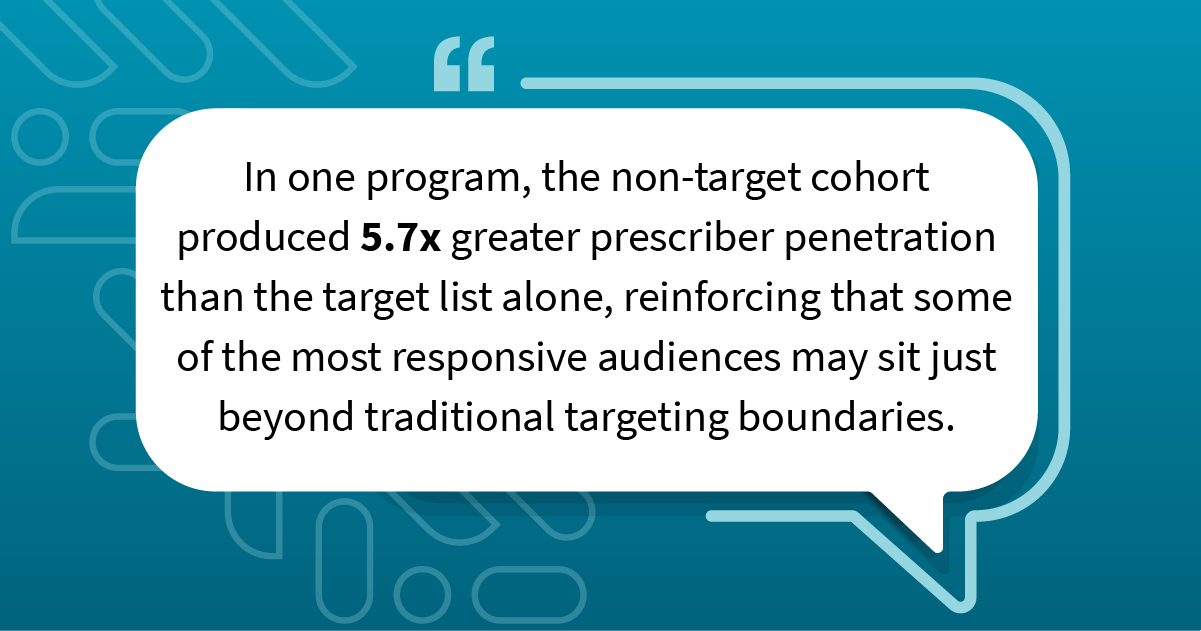
These whitespace audiences often include clinicians who are already seeing the relevant patients but are not yet prescribing the brand, creating meaningful opportunity for conversion. In one program, the non-target cohort produced 5.7x greater prescriber penetration than the target list alone, reinforcing that some of the most responsive audiences may sit just beyond traditional targeting boundaries. Notably, these campaigns maintained strong performance overall, with studied brands averaging 11:1 ROI in 2025.
It’s all about context — where and when your messaging is delivered makes a difference. When clinicians engage within trusted, logged-in clinical reference environments — researching dosing, reviewing safety information, or exploring treatment guidance — messaging is delivered in moments proximate to decision-making. Activation aligned to clinical intent allows brands to extend beyond static lists while maintaining measurable performance within core segments. Expansion becomes additive, not dilutive.
How Role Shapes Decision-Making
NPs and PAs are not simply lower-volume clinicians. Their day-to-day responsibilities frequently center on longitudinal patient engagement — follow-ups, therapy adjustments, adherence counseling, and care coordination across specialties.
According to CDC data, three in four U.S. adults live with at least one chronic condition, and more than half manage multiple conditions. In this environment, prescribing decisions are rarely isolated; they occur within ongoing management conversations shaped by real-world constraints.
That context influences how therapeutic trade-offs are evaluated. Clinical efficacy and safety remain foundational. But considerations such as route of administration, site-of-care flexibility, dosing simplicity, and patient burden often surface in routine care discussions.
Messaging that acknowledges both scientific rigor and practical implementation realities does not dilute credibility — it enhances relevance for a broader set of occupations. For instance, highlighting at-home administration options can resonate with clinicians who hear from patients that weekly hospital trips are a burden. Brands that tailor engagement to reflect these nuanced decision drivers are better positioned to capture incremental impact, not just impressions.
Static Lists in a Dynamic Ecosystem
The prescriber landscape is evolving rapidly. Care delivery is distributed across provider types, specialties, and settings. Static audience definitions, while still valuable, may no longer capture where opportunity resides.
Modern activation strategies layer multiple dimensions:
- Verified, logged-in clinician audiences across specialties and provider types
- Deterministic identification of advanced practice professionals
- First-party behavioral insights tied to clinical activity
- AI-powered analytics capable of surfacing emerging engagement patterns
The strategic question shifts from:
“Is this clinician on our list?”
to:
“Is this clinician actively engaging with content relevant to our category right now?”
Behavioral intelligence layered onto structured audience segmentation provides a dynamic, actionable understanding of prescribing signals.
Why the Stakes Are Rising
The U.S. patient population is aging, more medically complex, and frequently managed across distributed care teams. Chronic disease prevalence is high, polypharmacy is common, and treatment pathways often involve multiple clinicians.
When influence is distributed, limiting engagement to a subset of physicians preserves internal efficiency metrics but may leave significant opportunity unaddressed. Advanced practice professionals are central participants in the prescribing network. Their influence extends beyond volume — they educate patients, reinforce adherence, and manage therapy logistics. As their prescribing authority expands, so too does their relevance to brand growth.
From Coverage to Capture
Historically, pharma media strategy emphasized coverage:
- How fully did we reach our defined audience?
- How efficiently did we allocate spend within that universe?
The next inflection point emphasizes capture:
- How comprehensively are we influencing all clinicians contributing to prescribing volume?
- Where are incremental growth pockets emerging?
- How does strategy align with today’s workforce?
Coverage still maximizes efficiency within boundaries.
Capture, though, is about seizing growth wherever it exists.
In competitive categories, incremental script lift determines share leadership. Brands that saturate only historical physician deciles risk leaving influence on the table.
Designing for the Workforce in Motion
In epocrates’ analysis of prescribing data, advanced practice professionals now account for approximately one-quarter of prescriptions annually — and their influence continues to grow.
Precision still matters. But if we ignore where prescribing authority is actually shifting, we risk capping growth without even realizing it. If 25% of prescriptions originate from advanced practice professionals — and that share is rising — treating this segment as peripheral introduces structural inefficiency.
The brands that outperform will not simply intensify saturation within historical deciles. They will:
- Maintain targeting rigor while embracing expansion
- Protect efficiency while unlocking incremental opportunity
- Measure influence, not just reach
When growth occurs at the edges of traditional segmentation, ignoring those edges is not conservatism. It is missed opportunity. For brand and agency leaders committed to measurable ROI, the most consequential gains may not lie deeper within the target list. They may lie just beyond it.