

























The Global HCP Media Blueprint: From Fragmented Buys to Unified Engagement
Practical blueprint for unifying HCP engagement at scale without losing local relevance.

Written by Matt Durham – VP, Global Engagement Strategy – CMI Media Group
For some time now, many pharmaceutical companies have talked about “global” HCP media. In reality, most still operate a patchwork of local buying decisions, market-by-market interpretations of strategy, and siloed reporting frameworks that make true global media understanding almost impossible.
In my role as VP of Global at CMI Media Group, overseeing teams planning HCP media across 120+ markets, I see this tension every day. On the one hand, there is the understandable respect for local market nuances, different regulatory environments, different channel mixes, and the differences in how healthcare professionals consume information or engage with different channels and media tactics. On the other hand, there is a growing frustration at global, regional, and local levels that the siloed regional model is inefficient, opaque, and increasingly unfit for purpose.
This article sets out a practical, experience-led blueprint for moving from fragmented HCP media buys to a unified, auditable, and measurable global engagement system, without sacrificing local relevance. It is not about imposing a US-centric or above-market model on local or regional marketing team, nor about stripping markets of autonomy. It is about designing a global operating system that allows pharmaceutical companies to see, steer, and optimise HCP engagement across borders in a way that aligns with the scale of their ambitions.

The Reality of Fragmented HCP Media in Europe
Fragmentation in HCP media did not emerge by accident. In Europe especially, it is the natural outcome of decades of decentralised decision-making layered on top of genuine complexity.
Local affiliates have historically controlled their own budgets, selected their own publishers, and worked with local agencies or vendors who understand domestic medical media ecosystems. This made sense when media channels were predominantly print-based, digital was immature, and cross-market coordination offered little incremental value.
Today, however, the consequences of this legacy model are increasingly visible:
- Inconsistent engagement strategies across markets, even for the same brand and indication
- Duplicated effort and cost, with each market negotiating independently with the same multinational publishers
- Limited transparency, where global and regional teams struggle to understand where money is actually being spent
- A lack of data uniformity during the measurement of media campaigns, with different KPIs, methodologies, and reporting cadences across countries
The result is a paradox. Pharmaceutical companies are investing more than ever in HCP engagement, yet many cannot always answer basic questions with confidence:
Which channels are truly driving impact across a region? Where are we over-investing? Where are we under-serving key specialties?
Without a unified view, optimisation remains local and tactical, rather than strategic and global.
Why “Global” Cannot Mean “One-Size-Fits-All”
Before outlining a solution, it is important to be explicit about what a global HCP media blueprint is not.
It is not a central buying role dictating channels to Italy, Germany, or the Nordics with no regard for local regulation or practice. Anyone who has worked seriously in international pharma media knows that approach would fail almost immediately.
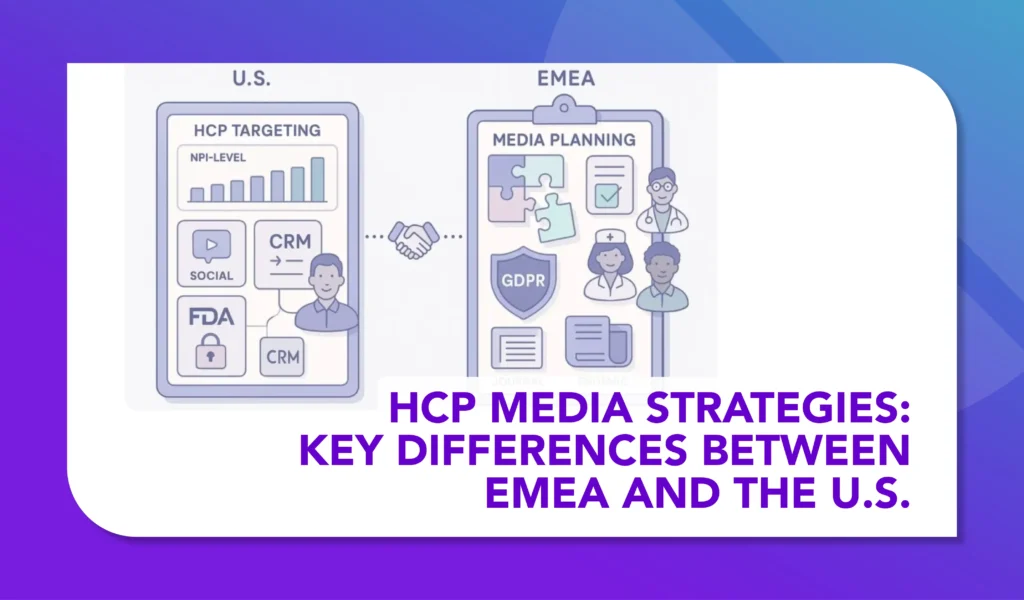
Europe for example, is not a single market. It is a federation of highly regulated, culturally distinct healthcare systems. A cardiologist in Spain does not consume media in the same way as one in Sweden. The compliance constraints in France differ materially from those in the UK. Ignoring these realities would undermine both effectiveness and trust.
A credible global model must therefore balance three forces:
- Global coherence. Meaning shared strategy, standards, and governance
- Regional coordination. With alignment across clusters with similar dynamics
- Local execution. Any market-specific activation informed by on-the-ground expertise, complimenting the activity happening above-market.
The blueprint I describe here is designed precisely to manage that tension.
The Case for a Global HCP Media Operating System
The core shift required is conceptual. Pharmaceutical companies must stop thinking about US HCP media as a collection of local buys and start thinking of it as a global operating system.
An operating system does not remove flexibility, it actually enables it. It sets common rules, languages, and interfaces so that different components can work together efficiently.
In a global HCP media context, this means:
- A single strategic framework for engagement across markets
- Standardised planning and buying principles, even when execution varies
- Unified data and measurement architecture
- Clear governance and accountability across global, regional, and local teams
This is where experienced global agency partners such as CMI Media Group have increasingly focused their efforts. Not simply as buyers of media, but as architects and stewards of these operating systems.
Step One: Establishing a Global Strategic Spine
Every effective global model starts with a shared strategic spine. Without it, coordination collapses into administration.
This spine should articulate, in clear and practical terms:
- Priority HCP audiences by specialty and influence level
- The role of paid media within the broader omnichannel engagement model
- Core channel roles (e.g. awareness, education, depth of engagement)
- Principles for frequency, sequencing, and continuity of messaging
Crucially, this is not a channel plan. It is a decision framework that markets can interpret locally.
In Europe, this approach has proven particularly valuable in therapeutic areas where HCP journeys are long and multi-touch. When markets understand why a channel is being used, not just what to buy, they are far more likely to align behind a common intent, even if the executional details differ.
Step Two: From Local Buying to Coordinated Investment
The most visible inefficiency in today’s model lies in how media is bought.
Across Europe for example, due to so much consolidation in the publisher space, it’s not uncommon for the same multinational publishers, medical portals, journals, email providers, etc, to be negotiated separately by 15, 20, or even 30 markets. This drives price variance, inconsistent value exchange, and fragmented access to data.
A global blueprint replaces this with coordinated investment, not forced centralisation.
In practice, this involves:
- Aggregating demand across markets to create negotiating leverage
- Establishing preferred global and regional partners with clear standards
- Allowing local opt-in within defined frameworks rather than ad hoc deals
Importantly, local markets can still activate and manage campaigns. What changes is that they do so within a structure that ensures fairness, transparency, and scalability.
From a European perspective, this model is particularly powerful in mid-sized markets that historically lack leverage. By being part of a coordinated system, they gain access to inventory, formats, and insights that were previously reserved for larger countries.
Step Three: Designing Measurement That Actually Scales
Measurement is where fragmentation does the most damage and where unification delivers the greatest return.
Many pharmaceutical companies today receive dozens of HCP media reports that cannot be meaningfully compared. Different metrics, different definitions, different levels of granularity. The result is reporting without learning.
A global HCP media blueprint introduces a tiered measurement framework:
- Global KPIs that are consistent across all markets
- Regional benchmarks that reflect structural differences
- Local metrics that support optimisation and compliance needs
This does not mean forcing identical dashboards everywhere. It means ensuring that data rolls up into a coherent global view.
In Asia-Pacific for example, where privacy regulation and data availability vary widely, this approach is essential. It allows markets to work within their constraints while still contributing to a shared understanding of performance.
Just as importantly, it enables something that has long been missing: cross-market learning. When metrics are aligned, best practice can travel across brand teams internationally.
Step Four: Governance Without Bureaucracy
One of the most common fears I encounter when discussing global models is bureaucracy. Markets worry about slower decision-making, more approvals, and less autonomy.
The solution lies in clarity of governance, not layers of control.
A well-designed global operating system defines:
- What decisions are made globally, regionally, and locally
- Who owns strategy, investment principles, and measurement standards
- How exceptions are handled, and importantly how often they should occur
When governance is explicit, friction decreases. Markets know the rules. Global teams know where to intervene and where to step back.
In my experience, local brand teams are not resistant to global alignment generally, but they are resistant to ambiguity. Give them a clear framework, and they will operate within it.
The Role of the Global Agency Partner
No pharmaceutical company can build and sustain this blueprint alone.
The role of a global HCP media agency has evolved significantly. It is no longer sufficient to be excellent buyers in individual markets. The real value now lies in coordination, orchestration, and accountability.
The right partner brings:
- Deep understanding of local global market dynamics
- The ability to aggregate and normalise data across borders
- Strong relationships with global and regional publishers
- Operational discipline to enforce standards without alienating markets
Critically, this partner must be structured to think globally while acting locally. In Europe for example, this often means strong regional leadership combined with empowered local teams, ideally mirroring the client’s own organisational reality.
From Engagement to Impact
Ultimately, the goal of a global HCP media blueprint is not efficiency for its own sake. It is impact.
When fragmentation is reduced, pharmaceutical companies gain:
- Clearer insight into what truly drives HCP engagement
- The ability to shift investment dynamically across markets, tactics and suppliers
- Greater confidence in paid media ROI discussions
- Stronger alignment between medical, commercial, and digital teams
Most importantly, they move closer to delivering what HCPs themselves increasingly expect: consistent, relevant, and respectful engagement, regardless of geography.
A Global Perspective on the Future
The next phase of international HCP media maturity lies in recognising that local excellence and global coherence are not opposing forces. They are complementary.
By investing in a unified global operating system, one that respects regional complexity while overcoming structural fragmentation, pharma marketing teams can move from disconnected activity to unified engagement.
The blueprint exists. Those who embrace it will not just buy media more efficiently. They will understand their HCP audiences better, act with greater confidence, and compete more effectively in an environment where attention, trust, and relevance are increasingly scarce.
And in today’s HCP media landscape, that is not a nice-to-have. It is a strategic imperative.