





























Reshaping Pharmaceutical Retail
How Digital Health Platforms Are Transforming Access, Engagement, and Outcomes Across China’s Healthcare Ecosystem

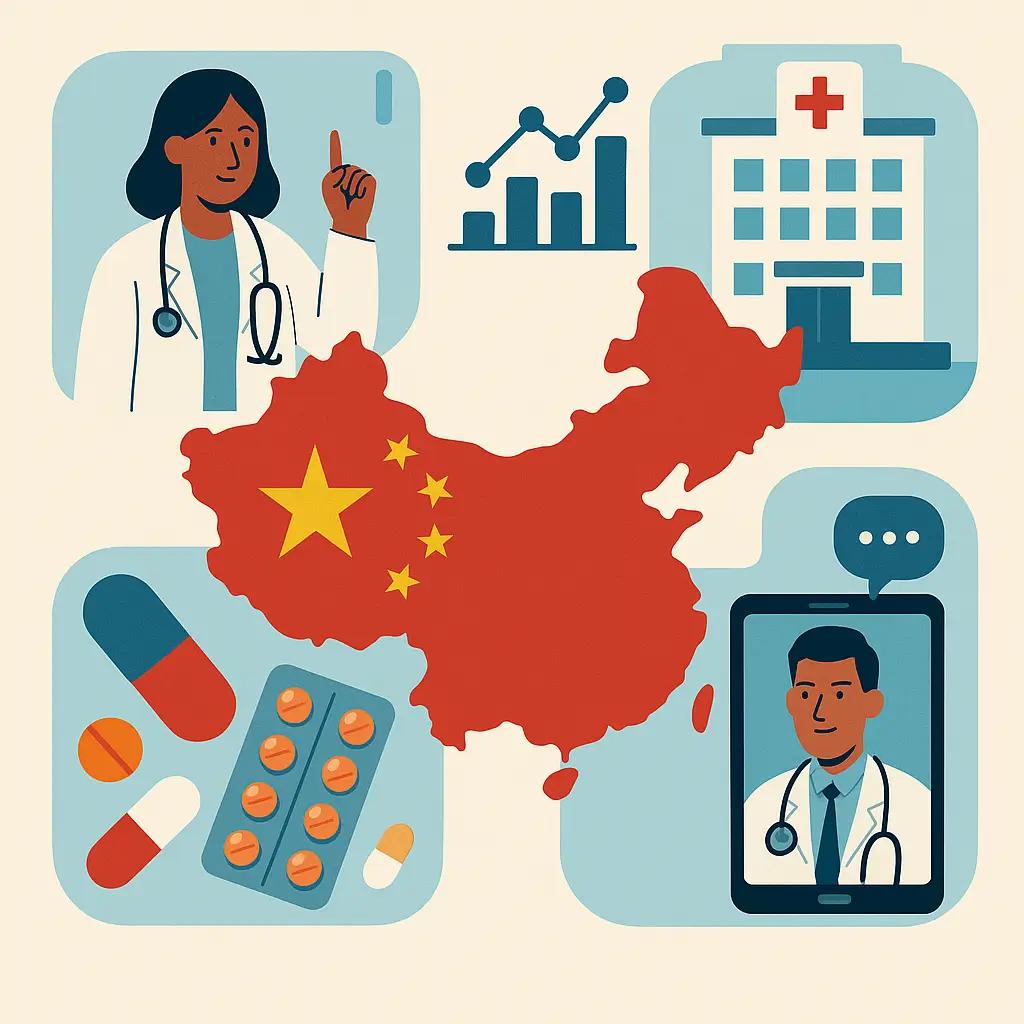
China’s pharmaceutical landscape is undergoing a profound digital transformation. The emergence of hybrid digital health platforms such as JD Health, Meituan health, and Ele.me health has created a “doctor + medicine” ecosystem that seamlessly connects telemedicine, e-prescriptions, insurance integration, and one-hour delivery.
Fueled by supportive policy reforms, urbanization, and evolving patient expectations, these platforms are redefining how healthcare is accessed, delivered, and commercialized. With China’s OTC and prescription drug market projected to exceed RMB 1.8 trillion (USD 248 billion) by 2035, digital retail channels are no longer peripheral—they are becoming central to pharma’s go-to-market (GTM) model.1 2
Key takeaway: Digital health platforms are becoming China’s new mainstream channel for both OTC and prescription medicines, reshaping how pharma reaches and serves patients.
A Digital Inflection Point in China’s Pharma Market
China’s pharmaceutical sector is entering a new era where digital health platforms are not just supporting access but actively shaping how patients connect to care, medicines, and health data.
- Online medicine sales surge: By 2024, China’s pharmaceutical retail market surpassed RMB 2.458 trillion, with online channels contributing nearly 15%, up from < 5% in 2020.2,3
- Platform scale: JD Health alone reached 150 million active users in 2025, demonstrating the rising appetite for digital-first healthcare.3,4
- O2O accessibility: Platforms like Meituan Pharmacy and Ele.me Health Pharmacy now guarantee one-hour drug delivery in 200+ cities, significantly improving medicine accessibility and patient convenience across China.3,5
- Insurance integration accelerating adoption: Provinces enabling 医保线上支付 (online reimbursement) saw explosive growth—Shanghai’s reimbursable drug sales rose 77% YoY after enabling this in 2024.2
- Capital intensity: Major players such as JD Health, Meituan, and Ele.me have invested over RMB 160 billion in logistics and subsidies over the past two years to capture user loyalty—raising the competitive bar while cementing digital health as the new default channel.6
Key takeaway: Rapid adoption, policy support, and massive investment have made digital health platforms the fastest-growing retail channel in China’s pharmaceutical industry.
Integrated Health Platforms as the New Commercial Infrastructure
Integrated health platforms are emerging as the backbone of China’s healthcare economy—linking consultation, e-prescription, payment, and delivery into a single, data-driven ecosystem.
- End-to-End Patient Journey: From symptom triage and teleconsultation to e-prescription, fulfillment, and chronic-care follow-up, platforms deliver a closed-loop care model.3,7
- Intelligent Logistics: Nationwide O2O and cold-chain networks ensure timely and compliant delivery of standard, specialty, and temperature-sensitive drugs.3,5
- Real-World Data & Precision Engagement: User profiles, purchase journeys, and feedback enable sharper market access strategies and tailored adherence programs.8,3
- Content & Influence: Through livestreams, expert Q&A, and medical education, platforms empower HCP voices and amplify brand storytelling.3, 8, 9
- Omnichannel Activation: Digital sampling, e-vouchers, and virtual product launches enable rapid uptake, with real-time analytics for continuous refinement.3,9
Key takeaway: These platforms now operate as full healthcare infrastructures—combining care delivery, logistics, data, and engagement in one intelligent ecosystem.
Unlocking New Value Across the Patient Journey
Pharma brands are moving beyond product transactions to deliver continuous patient value through digital support, personalized pathways, and real-world evidence generation.
- Nationwide Access: Platforms bridge gaps between urban and rural healthcare, offering massive patient bases and immediate scaling paths.3,4
- Digital Patient Support: Medication reminders, refills, and chronic care services become more effective, improving outcomes for diseases like diabetes and hypertension.10,11
- Real-World Evidence: Aggregated data from digital engagement supports regulatory filings, safety monitoring, and long-term lifecycle management.3,12
- Personalized Digital Pathways: Products can be bundled with diagnostics, telehealth access, and premium services to meet rising demand for comprehensive care.3,9
- First-Digital Launches: Brands can roll out new drugs or expanded indications online (first digital launch), rapidly gaining real-world feedback and market penetration, as seen with high-profile GLP-1 launches for weight management and diabetes care.3,9
Key takeaway: Digital-first launches let brands test, learn, and adapt in real time before scaling offline
Re-Defining Relationships Across the Healthcare Value Chain
Digital integration is dissolving traditional silos between pharma, HCPs, patients, and platforms, fostering a new model of shared data, aligned incentives, and connected care delivery.
| Stakeholder | New Role | Key Implications |
|---|---|---|
| Pharmaceutical Brands | From product suppliers to ecosystem co-creators | Partner with platforms to design digital pathways, harness real-world analytics, and sustain patient engagement. |
| Healthcare Professionals (HCPs) | From prescribers to digital influencers | Engage through remote consultations, content creation, and live Q&A to extend their clinical voice online. |
| Patients | From passive recipients to empowered participants | Enjoy on-demand access to care, transparent pricing, and continuous health support through mobile ecosystems. |
| Digital Health Platforms | From retailers to healthcare orchestrators | Ensure data privacy, regulatory compliance, and balanced partnerships while defining new engagement standards. |
Key takeaway: Digital platforms are uniting pharma, HCPs, and patients in a shared ecosystem where collaboration and data drive better access and outcomes.
Navigating the New Competitive Battlefield
Success in China’s new healthcare landscape demands digital fluency, ecosystem partnerships, and patient-centric innovation—where engagement and trust define competitive advantage. As digital platforms reshape the patient–HCP–pharma triangle, competitive differentiation now hinges on:
- Patient-centric innovation rather than pure product push.
- Regulatory fluency in an increasingly data-governed environment.
- Digital storytelling that educates, engages, and builds trust.
- Pharma leaders must evolve their channel strategies—from static distribution models to dynamic digital ecosystems capable of continuous learning and feedback.
Key takeaway: Winning in this new landscape requires mastering patient-centric design, compliance, and digital communication excellence.
Conclusion : Beyond Retail: Toward Intelligent, Connected Care
The rise of JD Health, Meituan health, and Ele.me health marks a paradigm shift in how China delivers healthcare. These hybrid digital channels—blending the best of internet hospitals, e-commerce, and instant medicine delivery—are not just incremental sales channels, but hubs of healthcare innovation, population-level engagement, and real-world data generation.
For pharmaceutical brands, this transformation calls for a strategic reset: embracing collaboration, designing for digital care journeys, and integrating data, empathy, and compliance into every engagement.
In China’s digital-health future, the winners will not just sell medicines—they will build ecosystems of trust, access, and continuous care.
Key takeaway: Digital health is redefining pharma’s future—from transactional sales to intelligent, ecosystem-based healthcare engagement.
List of notable Chinese digital health platform
From internet hospitals to instant-delivery pharmacies, China’s digital health landscape is shaped by two powerful forces—ecosystem integration and consumer-centric access—each transforming how healthcare is delivered and experienced.
| Healthcare Delivery Focus |
Retail & Commerce Focus |
|
|---|---|---|
| Ecosystem-Oriented (broad data + insurance integration) |
Ping An Good Doctor, WeDoctor, Alibaba Health |
JD Health, Alibaba Health |
| O2O / Consumer-Centric (instant access + convenience) |
Haodaifu Online, Dingdang Health |
Meituan Health, Ele.me Health |
- JD Health
JD Health is China’s largest online healthcare platform with over 150 million active users and more than 600,000 licensed healthcare professionals. It provides digital consultations, e-prescriptions, and medicine delivery in over 200 cities, often within 30 minutes. JD Health works with over 90% of top global pharma companies, offering integrated telemedicine, chronic care, and insurance payment services.11,12
- Meituan Health
Meituan Health leverages Meituan’s ecosystem to serve around 100 million monthly active users. It connects patients to over 150,000 healthcare providers via an O2O health network, covering more than 200 cities with average delivery under 60 minutes. It focuses on digital prescriptions and chronic care.13
- Ele.me Health
Ele.me Health, part of Alibaba Group, serves over 80 million active users and works with about 100,000 healthcare professionals. It supports medicine ordering and rapid delivery in 150+ cities, integrating Alibaba’s digital infrastructure for health and telehealth services.13
- Dingdang Health
Dingdang Health has over 40 million users and employs more than 30,000 licensed providers. Known for fast delivery—around 30 minutes in core cities—it covers 100+ cities, focusing on telemedicine, digital health, and chronic disease management.14
- Ping An Good Doctor (平安好医生):
One of the earliest and largest enterprise-led telemedicine platforms with over 270,000 registered doctors and millions of users. It offers comprehensive services from online consultations to health management and health fulfillment.7
- WeDoctor (微医):
A dominant player in internet hospital services and digital health management, integrating hospitals, doctors, and patients for online appointments, consultations, and chronic disease management across China.
- Haodaifu Online (好大夫在线):
Focuses on online consultation and medical education, connecting patients with specialists, and supporting telehealth services especially for non-emergency and follow-up care.7
- Alibaba Health (阿里健康): Apart from Ele.me Health, Alibaba Health operates a broad ecosystem covering pharmaceutical e-commerce, health data platforms, and AI-powered healthcare services.
Seowseng Tay, an APAC-based healthcare marketing leader, specializes in transforming medical science into compelling, market-ready communication.
Source:
- China – The Biggest OTC Markets – Chameleon Pharma Consulting
- China’s Pharmaceutical Retail Market Value Hits RMB 245.8 Billion
- Analyzing the Logic Behind JD Health’s High-quality Growth
- JD Health: Latest News and Updates
- MoonFox Data Releases New Report: Instant Retail
- China: Healthcare Marketing Trends in 2025
- Dingdang Health and the volatile pharmaceutical O2O industry
- Impact of digital integrated health platforms on diabetes
- Digital Healthcare 2025 – China | Global Practice Guides
- Healthcare AI 2025 – China – Global Practice Guides
- Transforming healthcare provider engagement using AI
- China’s online pharmacy: its regulatory policy and a future perspective
- JD Health Inks Multiple Cooperation Agreements
- The digital transformation in pharmacy: embracing online pharmacy and health apps